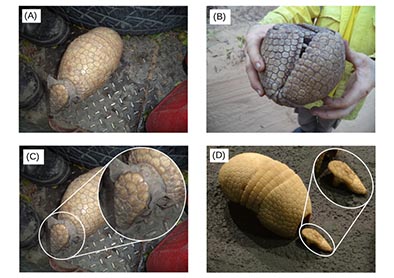
Registro da espécie Tolypeutes tricinctus Linnaeus, 1758 (Cingulata: Tolypeutinae) no norte do estado de Minas Gerais, Brasil
DOI:
https://doi.org/10.35699/2675-5327.2021.34678Palavras-chave:
Tatu-bola, Distribuição, Parque Nacional Grande Sertão Veredas, Conservação, BiogeografiaResumo
No presente trabalho apresentamos os primeiros registros de Tolypeutes tricinctus, o tatu-bola, no estado de Minas Gerais, Brasil. Este dado confirma estudos prévios de modelagem que abrangem a área de ocorrência da espécie para estas áreas de Cerrado e Caatinga no norte de Minas Gerais. Adicionalmente contribui para a elaboração de novos planos de manejo para a fauna da região que é adjacente ao Parque Nacional Grande Sertão Veredas.
Referências
Anacleto T.C.S., Diniz-Filho J.A.F. & Vital MVC (2006) Estimating potential geographic ranges of armadillos (Xenarthra, Dasypodidae) in Brazil under niche-based models. Mammalia, 70, 202-212.
Bocchiglieri A., Mendonça A.F. & Henriques R.P.B. (2010) Composição e diversidade de mamíferos de médio e grande porte no Cerrado do Brasil central. Biota Neotropica, 10 (3), 169-176.
Cetica P.D., Marcos H.J.A. & Merani M.S. (2005) Morphology of female genital tracts in Dasypodidae (Xenarthra, Mammalia): a comparative survey. Zoomorphology 124, 57–65.
Coimbra-Filho, A.F. (1972) Mamíferos ameaçados de extinção no Brasil. In: Academia Brasileira de Ciências, Espécies da fauna Brasileira Ameaçadas de Extinção. Rio de Janeiro GB, p. 13- 98.
Feijó A., Garbino G.S.T., Campos B.A.T., Rocha P.A., Ferrari S.F. & Langguth A. (2015) Distribution of Tolypeutes Illiger, 1811 (Xenarthra: Cingulata) with Comments on Its Biogeography and Conservation. Zoological Science, 32(1), 77-87.
Garrod A. H. (1878) Notes on the Anatomy of Tolypeutes tricinctus, with Remarks on other Armadillos. Proceedings of the Zoological Society of London, 46, 222-230
ICMBIO (2014) Sumário Executivo do Plano de Ação Nacional para a Conservação do Tatu-bola. Available from: https://www.gov.br/icmbio/pt-br/assuntos/biodiversidade/pan/pan-tatu-bola/1-ciclo/pan-tatu-bola-sumario.pdf (June 15, 2021).
ICMBIO (2018) Livro vermelho da fauna ameaçada de extinção. 1ª Edição. Brasília, 5, 622 pp.
Marinho-Filho J., Guimarães M., Reis M.L.,Rodrigues F., Torres O. & Almeida D. (1997) The discovery of the Brazilian three-banded armadillo in the Cerrado of Central Brazil. Edentata, 3, 11-13.
Ministério do Meio Ambiente/IBAMA/FUNATURA (2003) Plano de Manejo do Parque Grande Sertão Veredas. Available from: https://www.icmbio.gov.br/portal/images/stories/imgs-unidades-coservacao/parna_grande_sertao_veredas.pdf (June 14, 2021).
Miranda F., Moraes-Barros N., Superina M. & Abba, A.M. 2014. Tolypeutes tricinctus. The IUCN Red List of Threatened Species 2014. Available from: https://dx.doi.org/10.2305/IUCN.UK.2014-1.RLTS.T21975A47443455.en (June 14, 2021).
Moojen J. (1943) Alguns mamíferos colecionados no nordeste do Brasil. Boletim do Museu Nacional, 1, 1-19.
Oliveira T.G. (1995) The Brazilian three-banded armadillo Tolypeutes tricinctus in Maranhão. Edentata, 2, 18-19.
Paula, R.C.; Campos, C.B. & Morato, R.G. (2011) Mastofauna da bacia hidrográfica do rio São Francisco: Diagnóstico da mastofauna de médio e grande porte. In: Ministério do Meio Ambiente (ed.). Diagnóstico do macrozoneamento ecológico-econômico da Bacia Hidrográfica do Rio São Francisco, SEDR/DZT /MMA, pp. 266-277.
Reis M.L., Chiarello A.G., Campos C.B., Miranda F.R., Xavier G.A.A., Mourão G.M., Ohana, J.A.B., Moraes-Barros N. & Anacleto T.C.S. (2015) Avaliação do Risco de Extinção de Tolypeutes tricinctus (Linnaeus, 1758) no Brasil. ICMBio. Available from: http://www.icmbio.gov.br/portal/biodiversidade/fauna-brasileira/lista-de-especies/7113-mamiferos-tolypeutes-tricinctus-tatu-bola.html
Sanborn C.C. (1930) Distribution and Habits of the Three-banded Armdillo Tolypeutes. Journal of Mammalogy, 11, 61-68.
Santos I.B. (1993) Bionomia, distribuição geográfica e situação atual do tatu-bola Tolypeutes tricinctus (Linné, 1758) no nordeste do Brasil. Dissertação de Mestrado. Universidade Federal de Minas Gerais, Belo Horizonte, MG.
Santos I.B., Fonseca G.A.B., Rigueira S.E. & Machado R.B. (1994) The rediscovery of the Brazilian three-banded armadillo and notes on its conservation status. Edentata, 1, 11-15.
Silva J.M.C. & Oren D.C. (1993) Observations on the habitat and distribution of the Brazilian three-banded armadillo Tolypeutes tricinctus, a threatened Caatinga endemic. Mammalia 57, 149-151.
Superina M. & Abba A.M. (2020) Conservation perspectives for highly disparate lineage of mammals: the Xenarthra. Mastozoología Neotropical. 27, 47-66.
Wetzel R. M. (1982) Systematics, distribution, ecology and conservation of south american edentates. In: M. A. Mares e H. H. Genoways (Org.), Mammalian biology in South América, Pittsburg, University of Pittsburg, pp. 345–375.
Wetzel R. M. (1985) Taxonomy and distribution of armadillos, Dasypodidae. In: G. G. Montgomery (Ed.), The Ecology and Evolution of Armadillos, Sloths and Vermilinguas. Washington, DC, Smithsonian Institution Press, pp. 23-46.
Wetzel, R.M., Gardner A.L., Redford K.H. & Eisenberg J.F. (2007) Order Cingulata Illiger, 1811. In: Gardner A.L. (Ed.), Mammals of South America. Marsupials, Xenarthrans, Shrews, and Bats. Chicago, University of Chicago Press, pp.128-157.
Zimbres B.Q.C., Aquino P.P.U., Machado R.B., Silveira L., Jácomo A.T.A, Sollman R., Tôrres N.M., Furtado M.M. & Marinho-Filho J. (2012) Range shifts under climate change and the role of protected areas for armadillos and anteaters. Biological Conservation, 152, 53-61.