Male release calls of two gladiator treefrog species (Cophomantini, Boana faber species group), with an intrageneric acoustic comparison
DOI:
https://doi.org/10.35699/2675-5327.2026.64545Keywords:
Acoustic communication, Atlantic Forest, Hylidae, Neotropics, vocal repertoireAbstract
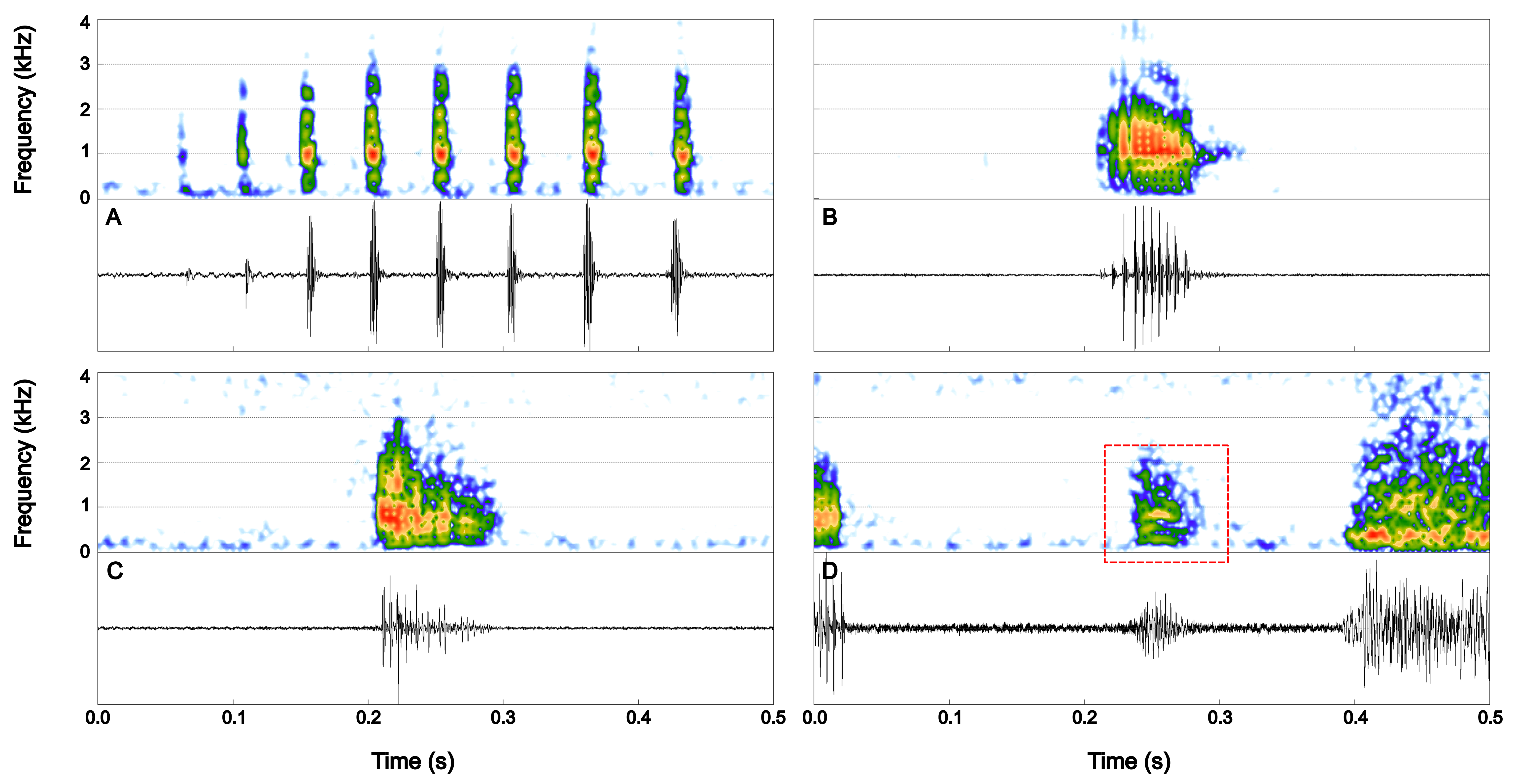
Anurans emit calls that convey different messages, depending on the context of emission. Reproductive calls mediate intraspecific interactions in reproductive contexts, and among these calls, the advertisement call is the most conspicuous and described type of call. It serves to attract mates, signalize aggression between conspecific males, and maintain space between chorus calling frogs. Another reproductive call, the release call, is emitted by males and females to signal non-receptiveness to a conspecific, or not, amplexus. Boana Gray, 1825, is a species-rich genus with a wide distribution in the Neotropical region, and the Boana faber species group (nested within Boana) is composed of nest-building gladiator frogs that use prepollical spines to defend their territory. The advertisement call is known for all species in the B. faber species group; however, the male release call is only known for one species of the group. Furthermore, the male release call is only known for five of the 101 species of Boana. In this study, we describe for the first time the male release call of Boana crepitans and Boana faber. Make intrageneric acoustic comparisons among the known male release calls for Boana. The male release call of both species is composed of a single type of note. Pulsed notes are ubiquitous in B. crepitans, but they can be pulsed, pulsatile, or non-pulsed in B. faber. Besides the temporal envelope, notes presented differences in duration: 209–449 ms in B. crepitans and 5–80 ms in B. faber, and in pulse repetition rate: 19–25 pulses/s in B. crepitans and 147–156 pulses/s in B. faber. Expanding our acoustic comparisons to Boana, we found much variation in the few described release calls for the genus. Our study also reveals the rarity of described male release calls for Boana, and, finally, we expanded the known male release calls descriptions to seven of the 101 known Boana species.
References
Audacity Team (2024) Audacity(r): free audio editor and recorder. Version 3.7.3. Available from: https://www. audacityteam.org (11 February 2026).
Bioacoustics Research Program (2024) Raven Pro: Interactive sound analysis software. Version 1.6.5. The Cornell Lab of Ornithology, Ithaca, New York, Computer software. Available from: https://ravensoundsoftware.com/ (11 February 2026)
Bogert C.M. (1960) The influence of sound on the behavior of amphibians and reptiles. In: Lanyon, W.E. & Tavolga, W.N. (Eds.), Animal sounds and communication. Washington, DC, AIBS, pp. 137-320.
Bowcock H., Brown, G.P., Shine, R. (2009). Beastly Bondage: The Costs of Amplexus in Cane Toads (Bufo marinus). Copeia, 1, 29-36. https://doi.org/10.1643/CE-08-036
Brunetti A.E., Taboada C., Faivovich J. (2015) Extended Vocal Repertoire in Hypsiboas punctatus (Anura: Hylidae). Journal of Herpetology, 49, 46-52. https://doi.org/10.1670/13-206
Casal F.C., Juncá F.A. (2008) Girino e canto de anúncio de Hypsiboas crepitans (Amphibia: Anura: Hylidae) do estado da Bahia, Brasil, e considerações taxonômicas. Boletim do Museu Paraense Emílio Goeldi - Ciências Naturais, 3, 217-224.
Dias T.M., Bastos R.P., Siqueira M.N., Morais A.R. (2014) The release call of Hypsiboas goianus (B. Lutz, 1968) (Anura: Hylidae) from Central Brazil. Herpetology Notes, 7, 217-217.
Faivovich J., Haddad C.F.B., Garcia P.C.A. et al. (2005) Systematic review of the frog family Hylidae, with special reference Hylinae: Phylogenetic analysis and taxonomic revision. Bulletin of the American Museum of Natural History, 294, 001-240. https://doi.org/10.1206/0003-0090(2005)294%255B0001:SROTFF%255D2.0.CO;2
Frost D.R. (2026). Amphibian Species of the World: an Online Reference. Version 6.2. Available from: https://amphibiansoftheworld.amnh.org/index.php (9 February 2026).
Grenat P.R., Martino L. (2013) The release call as a diagnostic character between cryptic related species Odontophrynus cordobae and O. americanus (Anura: Cycloramphidae). Zootaxa, 3635, 583-586. https://doi.org/10.11646/zootaxa.3635.5.8
Guerra V., Costa N.Q., Bastos R.P. (2018) Interspecific behaviour between two species of Boana (Anura: Hylidae) from central Brazil. Herpetology Notes, 11, 489-493.
Köhler J., Jansen M., Rodríguez A. et al. (2017) The use of bioacoustics in anuran taxonomy: theory, terminology, methods and recommendations for best practice. Zootaxa 4251, 001-124. https://doi.org/10.11646/zootaxa.4251.1.1
Ligges U., Krey S., Mersmann O., Schnackenberg S. (2023) tuneR: analysis of music and speech. Version: 1.4.7. Available from: https://CRAN.R-project.org/package=tuneR (13 February 2026)
Lopes P.D.N., Varago A., Portilho J. et al. (2024) Release call of Trachycephalus typhonius (Anura, Hylidae) in the Cerrado, Central-western Brazil. Journal of Vertebrate Biology, 73, 24072. https://doi.org/10.25225/jvb.24052
Lutz B. (1960) The Clay Nests of Hyla pardalis Spix. Copeia, 1960, 364-366. https://doi.org/10.2307/1439776
Lyra M.L., Lourenço A.C.C., Pinheiro P.D.P. et al. (2020). High-throughput DNA sequencing of museum specimens sheds light on the long-missing species of the Bokermannohyla claresignata group (Anura: Hylidae: Cophomantini). Zoological Journal of the Linnean Society 190, 1235-1255. https://doi.org/10.1093/zoolinnean/zlaa033
Mângia S., Carvalho P., Pereira E.A. et al. (2017) Release call of Scinax eurydice (Bokermann, 1968) (Anura, Hylidae) and advertisement call of northern populations. Herpetology Notes, 10, 237-243.
Mângia S., Camurugi F., Röhr D.L. et al. (2019) Release calls of four species of Phyllomedusidae (Amphibia, Anura). Herpetozoa, 32, 77-81. https://doi.org/10.3897/herpetozoa.32.e35729
Martins L.B., Silva W.R., Giaretta A.A. (2009) Distribution and calls of two South American frogs (Anura). Salamandra, 45, 106-109.
Martins M., Haddad C.F.B. (1988) Vocalizations and reproductive behaviour in the smith frog, Hyla faber Wied (Amphibia: Hylidae). Amphibia-Reptilia 9, 49-60. https://doi.org/10.1163/156853888X00206
Martof B.S., Thompson E.F. (1958) Reproductive behavior of the chorus frog, Pseudacris nigrita. Behaviour, 13,243-257. https://doi.org/10.1163/156853957X00038
McLister, J.D. (2003). The metabolic cost of amplexus in the grey tree frog (Hyla versicolor): assessing the energetics of male mating success. Canadian Journal of Zoology. 81, 388-394. https://doi.org/10.1139/z03-013
Orrico V.G.D., Nunes I., Mattedi C. et al. (2017) Integrative taxonomy supports the existence of two distinct species within Hypsiboas crepitans (Anura: Hylidae). Salamandra, 53, 99-113.
Pinheiro P.D.P., Blotto B.L., Ron S.R. et al. (2022). Prepollex diversity and evolution in Cophomantini (Anura: Hylidae: Hylinae). Zoological Journal of the Linnean Society, 195, 995-1021. https://doi.org/10.1093/zoolinnean/zlab079
R Core Team (2024) R: a language and environment for statistical computing. Version 4.4.2. R Foundation for Statistical Computing, Vienna. Available from: http://www.r-project.org (13 February 2026)
Röhr D.L., Juncá F.A. (2013) Micro-Habitat influence on the advertisement call structure and sound propagation efficiency of Hypsiboas crepitans (Anura: Hylidae). Journal of Herpetology, 47, 549-554. https://doi.org/10.1670/10-210
Santana E.M., Mendoza-Henao A.M., Vallejos J.G. (2025) The ‘silent’ half: diversity, function and the critical knowledge gap on female frog vocalizations. Proceedings of the Royal Society B, 292, 01-13. https://doi.org/10.1098/rspb.2025.0454
Schuck L.K., Moser C.F., Farina R.K. et al. (2024) The release call of Dendropsophus sanborni (Anura: Hylidae), with comments on release calls within Dendropsophus. Caldasia, 46, 161-166. https://doi.org/10.15446/caldasia.v46n1.101433
Siqueira J.V.C.D., Ramalho D.F., Freitas A.F.F.D. et al. (2025) Release call during interspecific amplexus in Boana raniceps (Cope, 1862): Evidence of acoustic variation from the Atlantic Forest of Northeast, Brazil. Open Access Library Journal, 12:1-9. https://doi.org/10.4236/oalib.1113633
Sueur J., Aubin T., Simonis C. (2008) Seewave, a free modular tool for sound analysis and synthesis. Bioacoustics, 18, 213-226. https://doi.org/10.1080/09524622.2008.9753600
Toledo L.F., Martins I.A., Bruschi D.P. et al. (2015) The anuran calling repertoire in the light of social context. Acta Ethologica, 18, 87-99. https://doi.org/10.1007/s10211-014-0194-4
Velasco I.G., Xavier V., Nunes I. (2025) Release call of two gladiator tree frogs Boana albomarginata (Spix, 1824) and B. semilineata (Spix, 1824) (Amphibia: Hylidae) in Atlantic Forest, Peruíbe, São Paulo, Brazil. Zootaxa, 5660, 147-150. https://doi.org/10.11646/zootaxa.5660.1.12
Vilaça T.R.A., Silva J.R.S., Solé M. (2011) Vocalization and territorial behaviour of Phyllomedusa nordestina Caramaschi, 2006 (Anura: Hylidae) from southern Bahia, Brazil. Journal of Natural History, 45, 1823-1834. https://doi.org/10.1080/00222933.2011.561018
Wells K.D. (1977) The social behaviour of anuran amphibians. Animal Behaviour 25, 666-693. https://doi.org/10.1016/0003-3472(77)90118-X
Wells K.D. (2007) The ecology & behavior of amphibians. Chicago, The University of Chicago Press, 1148 p.
Wilczynski W., Brenowitz E.A. (1988) Acoustic cues mediate inter-male spacing in a neotropical frog. Animal Behaviour, 36, 1054-1063. https://doi.org/10.1016/S0003-3472(88)80065-4.
Downloads
Published
Issue
Section
License
Copyright (c) 2026 Lucas Vilela de Carvalho Rodrigues, Gabriel Costa Santos, Alejandra María Salazar Guzmán , Lara Carias, Thales Lacerda Araujo, Júlia Samos, Thiago Ribeiro de Carvalho

This work is licensed under a Creative Commons Attribution-NonCommercial 4.0 International License.
