¿Y si el ajolote respondiera?
antropogénesis y antropocentrismo en Idea dell'infanzia, de Giorgio Agamben
DOI:
https://doi.org/10.53981/destroos.v2i1.34306Palabras clave:
antropocentrismo, Giorgio Agamben, biopolítica, estudios animalesResumen
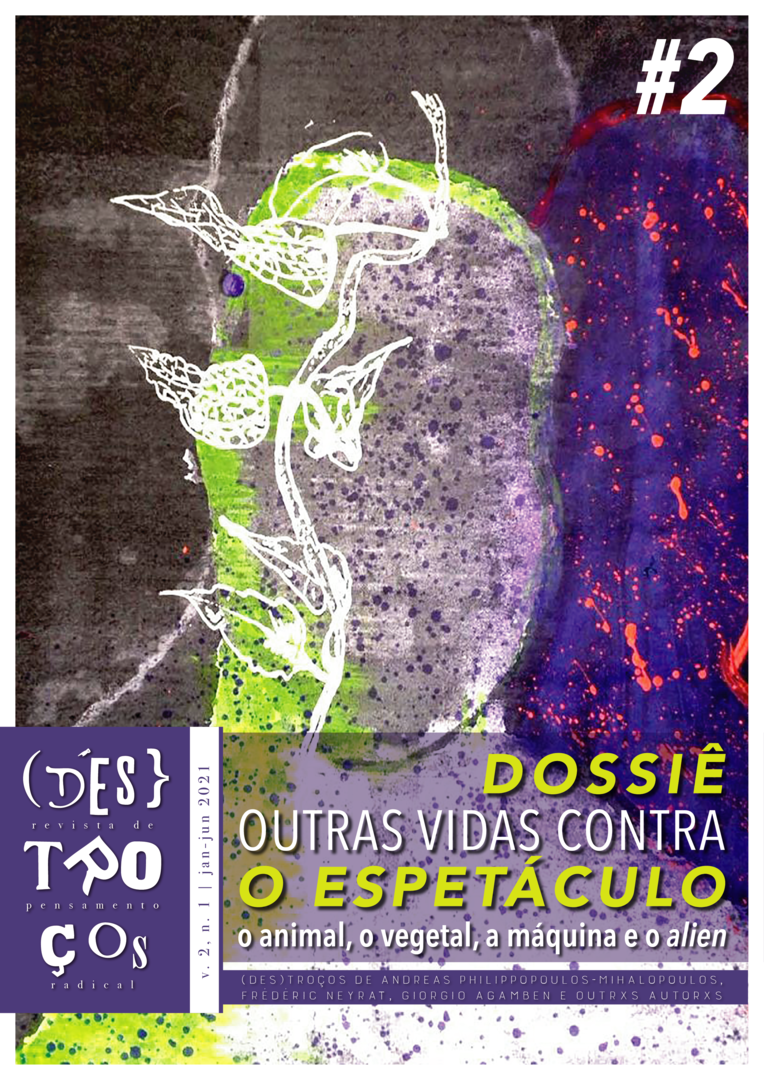
En este artículo pretendemos presentar uno lectura crítica de la sección Idea dell'infanzia del libro Idea della prosa, de Giorgio Agamben. Basado en las reflexiones de Agamben en el libro más más adelante – L'aperto –, leeremos la caracterización de la oposición entre el ajolote y el infante neoténico como una narrativa antropogenética que informa un imaginación política antropocéntrica.
Descargas
Referencias
AGAMBEN, Giorgio. Idea della prosa. Milano: Feltrinelli, 1985.
AGAMBEN, Giorgio. Infanzia e storia. Torino: Einaudi, 2001.
AGAMBEN, Giorgio. L’amico. Roma: Nottetempo, 2007.
AGAMBEN, Giorgio. L’aperto: l’uomo e l’animale. Torino: Bollati Boringhieri, 2002.
AGAMBEN, Giorgio. O que é um dispositivo & o amigo. Trad. Vinícius Nicastro Honesko. Chapecó: Argos, 2014.
ARISTÓTELES. Ética a Nicômacos. Trad. Mário da Gama Kury. 3. ed. Brasília: Editora da Universidade de Brasília, 1999.
BATAILLE, Georges. Teoria da religião. Trad. Fernando Scheibe. Belo Horizonte: Autêntica, 2015.
BODDICE, Rob. The end of anthropocentrism. In: BODDICE, Rob (org.). Anthropocentrism: humans, animals, environments. Leiden: Brill, pp. 1-20, 2011.
BUTCHVAROV, Panayot. Anthropocentrism in philosophy. Berlim: De Gruyter, 2015.
CALARCO, Matthew. Zoographies: the question of the animal from Heidegger to Derrida. New York: Columbia University, 2008. E-book.
CASTRO, Edgardo. Introdução a Giorgio Agamben: uma arqueologia da potência. Trad. Beatriz de Almeida Magalhães. Belo Horizonte: Autêntica, 2013.
CÓRDOBA, Ernesto Aréchiga. De la exuberancia al agotamiento. Xochimilco y el agua, 1882-2004. In: LÓPEZ, María Eugenia (org.). A la orilla del agua: historia de Xochimilco en el siglo XX. México: Instituto Mora, pp. 97-152, 2004.
COUTINHO, Juliana Fausto de Souza. A cosmopolítica dos animais. 2017. Tese (Doutorado em Filosofia) – Pontifícia Universidade Católica do Rio de Janeiro, Rio de Janeiro, 2010. Disponível em: https://www.maxwell.vrac.puc-rio.br/32505/32505.PDF. Acesso: 20 maio 2021.
CRAGNOLINI, Mônica. Extraños animales: filosofía y animalidad en el pensar contemporâneo. Buenos Aires: Prometeo, 2016.
DANOWSKI, Déborah; VIVEIROS DE CASTRO, Eduardo. Há mundo por vir? Ensaio sobre os medos e os fins. Florianópolis: Cultura e Barbárie; Instituto Socioambiental, 2014.
DERRIDA, Jacques. “Il faut bien manger” ou le calcul du sujet. In: WEBER, Elisabeth (org.). Points de suspension. Paris: Galilée, pp. 269-302, 1992.
DERRIDA, Jacques. L’animal que donc je suis. Paris: Éditions Galilée, 2006.
DERRIDA, Jacques. La bête et le souverain. Vol. I (2001-2002). Paris: Éditions Galilée, 2008.
DESCOLA, Philippe. Constructing natures: symbolic ecology and social practice. In: DESCOLA, Philippe; PÁLSSON, Gísli (orgs.). Nature and society: anthropological perspectives. Nova York, Routledge, pp. 82-102, 1996.
DESCOLA, Philippe. Estrutura ou sentimento: a relação com o animal na Amazônia. Trad. Tânia Stolze Lima. Mana 4, v. I, pp. 23-45, 1998. Disponível em: https://www.scielo.br/j/mana/a/yFVLXtKkcyTLBYhYc8Hd8XN/abstract/?lang=pt. Acesso: 20 maio 2021.
FLEISNER, Paula. Hominización y animalización: una genealogia de la diferenciación entre hombre y animal en el pensamento agambeniano. Contrastes: Revista Internacional de Filosofía, vol. XV, pp. 337-352, 2010. Disponível em: https://www.uma.es/contrastes/pdfs/015/ContrastesXV-18.pdf. Acesso: 20 jun. 2021.
FOUCAULT, Michel. História da sexualidade: a vontade de saber. Vol. I. 6. ed. Trad. Maria Thereza da Costa Albuquerque e J. A. Guilhon Albuquerque. Rio de Janeiro: Paz e Terra, 2017.
JESI, Furio. La festa: antropologia etnologia folklore. Turim: Rosenberg & Sellier, 1977.
LÉVI-STRAUSS, Claude. Les structures élémentaires de la parenté. 2. ed. Berlin: Mouton de Gruyter, 2002.
LÓPEZ, María Eugenia Terrones. Xochimilco sin arquétipo: historia de una integración urbana acelerada en el siglo XX. Scripta Nova: Revista Electrónica de Geografía y Ciencias Sociales, Universitat de Barcelona, vol. X, n. 218 (37), sem paginação, 2006. Disponível em: http://www.ub.edu/geocrit/sn/sn-218-37.htm. Acesso: 20 jun. 2021.
MARCHESINI, Roberto. Alterity and the non-human. Humanimalia, vol I, n. 2, pp. 91-96, 2010. Disponível em: https://www.depauw.edu/humanimalia/issue02/pdfs/Marchesini.pdf. Acesso: 20 jun. 2021.
MASSUMI, Brian. O que os animais nos ensinam sobre política. Trad. Francisco Trento e Fernanda Mello. São Paulo: n-1, 2017.
MESNARD, Philippe. The political philosophy of Giorgio Agamben: a critical evaluation. Totalitarian Movements and Political Religions, v. 5, n. 1, pp. 139-157, 2004. Disponível em: https://www.tandfonline.com/doi/full/10.1080/1469076042000223437. Acesso em: 20 jun. 2021.
NIMMO, Richie. The making of the human: anthropocentrism in modern social thought. In: BODDICE, Rob (org.). Anthropocentrism: humans, animals, environments. Leiden: Brill, pp. 59-80, 2011.
PARDINI, Patrick. Amazônia indígena: a floresta como sujeito. Boletim do Museu Paraense Emílio Goeldi. Ciências Humanas, n. 15, pp. 1-11, 2020. Disponível em: https://www.scielo.br/j/bgoeldi/a/hjXGBwPTD6Fnh7vKDRWvnPN/?lang=pt#. Acesso: 20 maio 2021.
PRÓSPERI, Germán Osvalo. La máquina elíptica de Giorgio Agamben. Profanações, ano 2, n. 2, pp. 62-83, jul./dez. 2015. Disponível em: https://doi.org/10.24302/prof.v2i2.945. Acesso: 20 maio 2021.
RABINOW, Paul; ROSE, Nikolas. Biopower today. BioSocieties, vol. I, pp. 195-217. 2006. Disponível em http://anthropos-lab.net/wp/publications/2007/01/rabinow-rose.pdf. Acesso: 20 maio 2021.
TONUTTI, Sabrina. Anthropocentrism and the definition of ‘culture’ as a marker of the human/animal divide. In: BODDICE, Rob. Anthropocentrism: humans, animals, environments. Leiden: Brill, pp. 183-202, 2011.
WANDERER, Emily. The axolotl in global circuits of knowledge production: producing mulispecies potentiality. Cultural Anthropology, vol. 33, n. 4, pp. 650-679, 2018. Acesso: 20 maio 2021.
Descargas
Publicado
Número
Sección
Licencia
Derechos de autor 2021 (Des)troços: revista de pensamento radical

Esta obra está bajo una licencia internacional Creative Commons Atribución-NoComercial 4.0.
Cómo citar