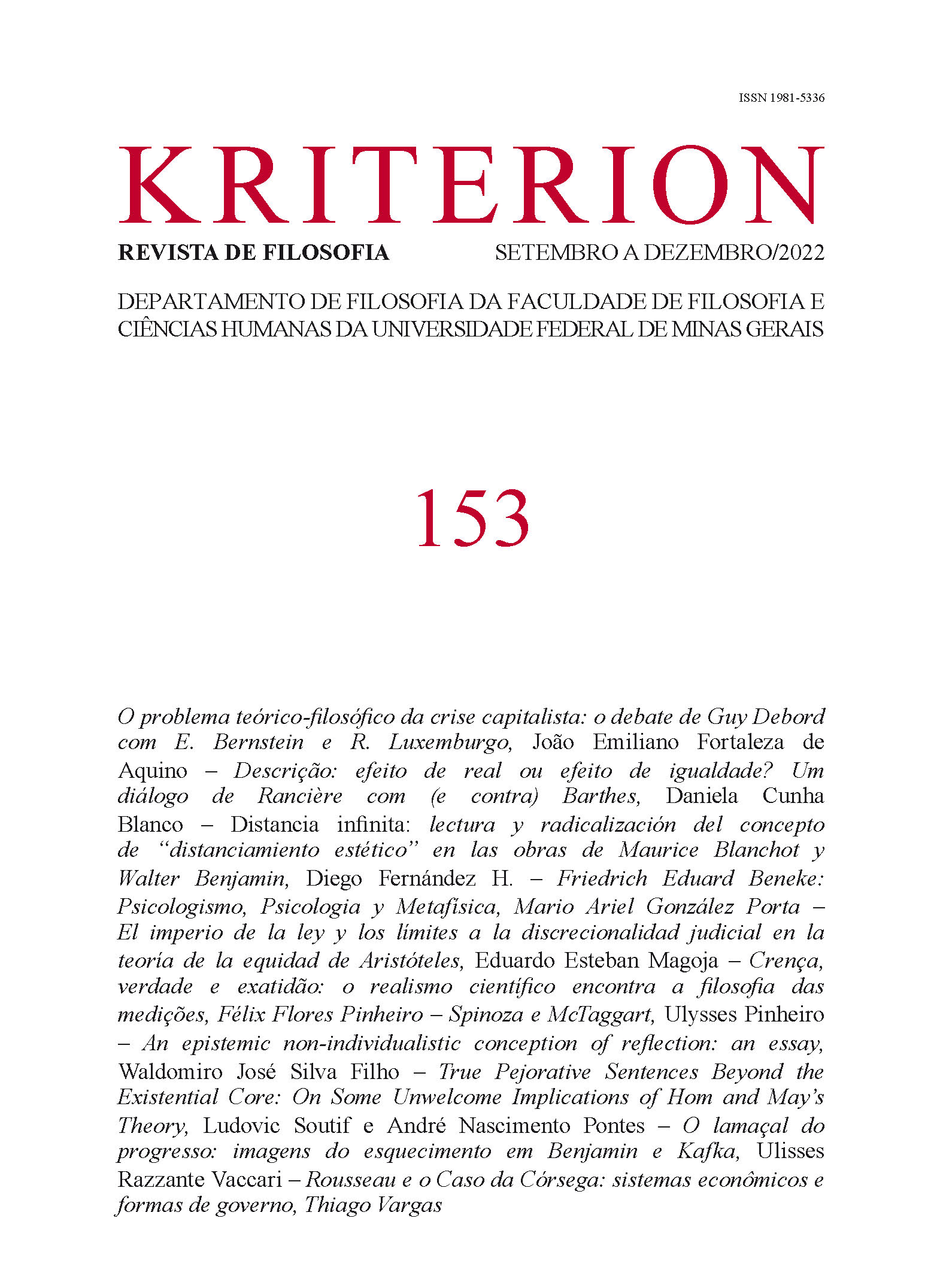
EL IMPERIO DE LA LEY Y LOS LÍMITES A LA DISCRECIONALIDAD JUDICIAL EN LA TEORÍA DE LA EQUIDAD DE ARISTÓTELES
Palavras-chave:
equity, judge, emotions, Aristotle, lawResumo
La teoría de la equidad de Aristóteles ha sido entendida en general de dos diferentes maneras en la literatura especializada. Una parte de los autores sostiene que la equidad se trata de un criterio extranormativo, en el sentido de que va más allá de la ley y alcanza un nivel supralegal que se identifica con un orden metafísico de una justicia natural. Otra parte, en cambio, afirma que la equidad es intranormativa, en el sentido de que el juez lleva a cabo una rectificación de la justicia legal sin salirse de sus contornos. A la luz de esta última lectura y mediante una metodología que entrecruza la filosofía del derecho y algunas de las principales teorías sobre las emociones en la Grecia antigua, el propósito de este trabajo es demostrar que, de acuerdo con el pensamiento de Aristóteles, los jueces equitativos no deben tener amplia discrecionalidad. A los fines de mostrar este punto, se abordará en particular el papel de las emociones en la formación del juicio y la capacidad que tienen para poner en peligro el dictado de decisiones justas y racionales.
Referências
ANAGNOSTOPOULOS, G. (ed.). “A Companion to Aristotle”. Oxford: Wiley-Blackwell, 2009.
______. “The Blackwell Companion to Aristotle”. Oxford: Blackwell, 2009.
BARNES, J. (ed.). “The Cambridge Companion to Aristotle”. Cambridge: University Press, 1995.
BARNES, J. “Rhetoric and Poetics”. En: Barnes, J. (ed.), 1995, pp. 259-286.
BEEVER, A. “Aristotle on Justice, Equity, and Law”. Legal Theory, 10, 2004, pp. 33-50.
BOBONICH, C. “Aristotle, Political Decision Making and the Many”. En: Lockwood, T. & Samaras, T. (eds.), 2015, pp. 142-162.
BRADY, M. “The Irrationality of Recalcitrant Emotions”. Philosophical Studies, 145, 2008, pp. 413-430.
BRINTON, A. “Pathos and the ʻAppeal to Emotionʼ: An Aristotelian Analysis”. History of Philosophy Quarterly, 5(3), 1988, pp. 207-219.
BRUNSCHWIG, J. “Rule and Exception: On the Aristotelian Theory of Equity”. En: Frede, M. & Striker, G. (eds.), 1996, pp. 115-155.
BURTT, J. O. (ed. & trad.). “Minor Attic Orators II: Lycurgus, Dinarchus, Demades, Hyperides”. Londres: Heinemann (Loeb Classical Library), 1962.
BYWATER, I. (ed.). “Aristotelis. Ethica Nicomachea”. Oxford: Clarendon Press, 1988.
CAREY, C. “Rhetorical Means of Persuasion”. En: Worthington, I. (ed.), 1994, pp. 26-45.
CHIRON, P. “Aristote. Rhétorique”. París: Flammarion, 2007.
CHROUST, A.-H. “Aristotleʼs Conception of Equity (Epieikeia)”. Notre Dame Law Review, 18(2), 1942, pp. 119-128.
COOPER, J. M. “An Aristotelian Theory of the Emotions”. En: Rorty, A. O. (ed.), 1996, pp. 238-257.
______. “Rhetoric, Dialectic, and the Passions”. Oxford Studies in Ancient Philosophy, 11, 1993, pp. 175-198.
______. “Reason and Emotion: Essays on Ancient Moral Psychology and Ethical Theory”. Princeton: University Press, 1999.
DʼAGOSTINO, F. “Epieikeia: il tema dellʼequità nellʼantichità greca”. Milán: A. Giuffrè, 1973.
DESLAURIERS, M., DESTRÉE, P. (eds.). “The Cambridge Companion to Aristotleʼs Politics”, Cambridge: University Press, 2013.
DIRLMEIER, F. (ed.). “Aristoteles: Nikomachische Ethik”. Berlín: Akademie Verlag, 1956.
DOW, J. “A Supposed Contradiction about Emotion-Arousal in Aristotleʼs Rhetoric”. Phronesis, 52(4), 2007, pp. 382-402.
______. “Aristotleʼs Theory of the Emotions: Emotions as Pleasures and Pains”. En: Pakaluk, M. & Pearson, G. (eds.), 2011, pp. 47-74.
______. “Passions and Persuasion in Aristotleʼs Rhetoric”. Oxford: University Press, 2015.
FREDE, M., STRIKER, G. (eds.). “Rationality in Greek Thought”. Oxford: University Press, 1996.
GARDNER, J. “The Virtue of Justice and the Character of Law”. Current Legal Problems, 53, 2000, pp. 149-184.
GEORGIADIS, C. “Equitable and Equity in Aristotle”. En: Panagiotou, S. (ed.), 1987, pp. 115-156.
GIGON, O. (ed.). “Aristotelis Opera. Vol III: Librorum Deperditorum Fragmenta”. Berlín: de Gruyter, 1987.
GOLDIE, P. (ed.). “The Oxford Handbook of Philosophy of Emotion”. Oxford: University Press, 2009.
GRIMALDI, W. “Studies in the Philosophy of Aristotleʼs Rhetoric”. Wiesbaden: Franz Steiner Verlag, 1972.
GUARIGLIA, O. “La Ética en Aristóteles o la Moral de la Virtud”. Buenos Aires: Eudeba, 1997.
HAMBURGER, M. “Morals and Law: The Growth of Aristotleʼs Legal Theory”. Nueva York: Biblo & Tannen, 1965.
HARRIS, E. M. “The Rule of Law in Action in Democratic Athens”. Oxford: University Press, 2013.
HEWITT, A. “Universal Justice and Epieikeia in Aristotle”. Polis: The Journal for Ancient Greek and Roman Political Thought, 25, 2008, pp. 115-130.
HOBBES, T. (1651). “Leviatán: o la materia, forma y poder de una república eclesiástica y civil”. Buenos Aires: FCE, 2007.
HORN, C. “Epieikeia: The Competence of the Perfectly Just Person in Aristotle”. En: Reis, B. (ed.), 2006, pp. 142-166.
HUPPES-CLUYSENAER, L., COELHO, N. M. (eds.). “Aristotle and The Philosophy of Law: Theory, Practice and Justice”. Dordrecht: Springer, 2013.
HUPPES-CLUYSENAER, L., COELHO, N. M. (eds.). “Aristotle on Emotions in Law and Politics”. Dordrecht: Springer, 2018.
HUPPES-CLUYSENAER, L. “The Debate About Emotion in Law and Politics”. En: Huppes-Cluysenaer, L. & Coelho, N. M. (eds.), 2018, pp. 3-10.
IRWIN, T. (trad.). “Nicomachean Ethics”. Indianapolis: Hackett, 1999.
______. “Ethics in the Rhetoric and in the Ethics”. En: Rorty, A. O. (ed.), 1996, pp. 142-174.
JOACHIM, H. H. “Aristotle. The Nicomachean Ethics: A Commentary”. Oxford: University Press, 1951.
JOHNSTONE, C. L. “An Aristotelian Trilogy: Ethics, Rhetoric, Politics, and the Search for Moral Truth”. Philosophy & Rhetoric, 13(1), 1980, pp. 1-24.
JOHNSTONE, S. “Disputes and Democracy: The Consequences of Litigation in Ancient Athens”. Austin: University of Texas Press, 1999.
KASSEL, R. (ed.). “Aristotelis. Ars Rhetorica”. Berlín: de Gruyter, 1976.
KENNEDY, G. (trad.). “Aristotle. On Rhetoric: A Theory of Civic Discourse”. Oxford: University Press, 2007.
______. “Review of William A. Grimaldi, Aristotle, Rhetoric I. A Commentary”. American Journal of Philology, 106, 1985, pp. 131-133.
KÖNCZÖL, M. “Legality and Equity in the Rethoric: The Smooth Transition”. En: Huppes-Cluysenaer, L. & Coelho, N. M. (eds.), 2013, pp. 171-201.
KONSTAN, D. “The Emotions of the Ancient Greeks: Studies in Aristotle and Classical Literature”. Toronto: University Press, 2006.
LAMAS, F. A. “La Experiencia jurídica”. Buenos Aires: Instituto de Estudios Filosóficos Santo Tomás de Aquino, 1991.
LANDEMORE, H. “Democratic Reason: Politics, Collective Intelligence, and the Rule of the Many”. Princeton: University Press, 2013.
LANNI, A. “Las normas sociales en las cortes de un juicio ateniense”. Revista Jurídica de Buenos Aires, 42(94), 2017, pp. 61-102.
______. “Law and Justice in the Courts of Classical Athens”. Cambridge: University Press, 2006.
LAZARUS, R. S. “Cognition and Motivation”. American Psychologist, 46, 1991, pp. 352-367.
LEIGHTON, S. R. “Aristotle and the Emotions”, Phronesis, 27, 1982, pp. 144-174.
______. “Passions and Persuasion”. En: Anagnostopoulos, G. (ed.), 2009, pp. 297-312.
LELL, H. M. “La equidad y la seguridad jurídica. El equilibrio como desafío a la ética judicial”. Lex Humana, 9(1), 2017, pp. 26-45.
LOCKWOOD, T., SAMARAS, T. (eds.). “Aristotleʼs Politics. A Critical Guide”. Cambridge: University Press, 2015.
MASSINI CORREAS, C. I. “La sistemática de la justicia en la filosofía de Aristóteles”. Persona y Derecho, 39, 1998, pp. 237-286.
MCCORMACK, K. C. “Ethos, Pathos, and Logos: The Benefits of Aristotelian Rhetoric in the Courtroom”, Washington University Jurisprudence Review, 7(1), 2014, pp. 131-155.
MILLER, F. D. “The Rule of Reason”. En: Deslauriers, M. & Destrée, P. (eds.), 2013, pp. 38-66.
MOSS, J. “Aristotle on the Apparent Good: Perception, Phantasia, Thought, and Desire”. Oxford: University Press, 2012.
NUSSBAUM, M. “Emotion in the Language of Judging”. St. Johnʼs Law Review, 70(1), 1996, pp. 23-30.
______. “Hiding from Humanity: Disgust, Shame and the Law”. Princeton: University Press, 2004.
______. “La terapia del deseo. Teoría y práctica en la ética helenística”. Barcelona: Paidós, 2012.
______. “Upheavals of Thought: The Intelligence of Emotions”. Cambridge: University Press, 2001.
OATES, W. J. “Aristotle and the Problem of Value”. Princeton: University Press, 1993.
PAKALUK, M., PEARSON, G. (eds.). “Moral Psychology and Human Action in Aristotle”. Oxford: University Press, 2011, pp. 47-74.
PALLÍ BONET, J., CALVO MARTÍNEZ, T. (trads.). “Ética”. Madrid: Gredos, 2007.
PANAGIOTOU, S. (ed.). “Justice, Law, and Method in Plato and Aristotle”. Edmonton: Academic Printing & Publishing, 1987.
PRICE, A. “Emotions in Plato and Aristotle”. En: Goldie, P. (ed.), 2009, pp. 121-142.
RAPP, C. “Dispassionate Judges Encountering Hotheaded Aristotelians”. En: Huppes-Cluysenaer, L. & Coelho, N. M. (eds.), 2018, pp. 27-49.
______. “The Nature and Goals of Rhetoric”. En: Anagnostopoulos, G. (ed.), 2009, pp. 577-596.
REIS, B. (ed.). “The Virtuous Life in Greek Ethics”. Cambridge: University Press, 2006.
RODRÍGUEZ, J. L. “Lagunas axiológicas y relevancia normativa”. Doxa, 22, 1999, pp. 349-369.
ROMILLY, J. de. “La douceur dans la pensée grecque”. París: Les Belles Lettres, 1979.
RORTY, A. O. (ed.). “Essays on Aristotleʼs Rhetoric”. Berkeley: University of California Press, 1996.
______. O. “Aristotle on the Virtues of Rhetoric”. The Review of Metaphysics, 64(4), 2011, pp. 715-733.
ROSS, W. D. (ed.). “Aristotelis. Politica”. Oxford: Clarendon Press, 1957.
______. “Aristotle. De Anima”. Oxford: Clarendon Press, 1956.
SANDERS, E. “Persuasion Through Emotions in Athenian Deliberative Oratory”. En: Sanders, E. & Johncock, M. (eds.), 2016, pp. 57-73.
SANDERS, E., JOHNCOCK, M. (eds.). “Emotion and Persuasion in Classical Antiquity”. Stuttgart: Franz Steiner Verlag, 2016.
SHINER, R. “Aristotleʼs Theory of Equity”. Loyola of Los Angeles Law Review, 27(4), 1994, pp. 1245-1264.
SINNOTT, E. (trad.). “Aristóteles. Ética Nicomaquea”. Buenos Aires: Colihue, 2007.
SOLOMON, R. “The Passions: Emotions and the Meaning of Life”. Nueva York: Anchor Press/Doubleday, 1976.
SUCRE, A. “Aristotleʼs Conception of Equity in Context” [Tesis de maestría, University of Missouri-St. Louis], 2013. Disponible en https://irl.umsl.edu/thesis/201 (Consultado el 15 de noviembre de 2021).
SUSEMIHL, F. (ed.). “Aristotelis. Magna Moralia”. Leipzig: Teubner, 1883.
TALE, C. “La equidad o epiqueya (Concepto, criterios y aplicaciones)”. Córdoba: Trejo y Sanabria, 2011.
TOMÁS DE AQUINO. “In Decem Libros Ethicorum Aristotelis ad Nicomachum Expositio”. ed. Spiazzi, R., Turín: Marietti, 1964.
VECCHIO, G. de. “La justicia”. Buenos Aires. Depalma, 1952.
VEGA, J. “La actualidad de la equidad de Aristóteles. Doce tesis antiformalistas sobre el derecho y la función judicial”. Cuadernos Electrónicos de Filosofía del Derecho, 29, 2014b, pp. 113-144. Disponible en https://roderic.uv.es/handle/10550/37509 (Consultado el 3 de noviembre de 2021).
______. “Legal Rules and Epieikeia in Aristotle. Post-positivism Rediscovered”. En: Huppes-Cluysenaer, L. & Coelho, N. M. (eds.), 2013, pp. 171-201.
______. “Reglas prácticas y equidad en Aristóteles”. Anuario de filosofía del derecho, 30, 2014a, pp. 413-463.
VERNENGO, R. “Sobre algunas funciones de la equidad”. La Ley, Tomo 155, 1974, pp. 1200-1209.
WALDRON, W. “The Wisdom of the Multitude: Some Reflections on Book 3, Chapter 11 of Aristotleʼs. Politics”. Political Theory, 23(4), 1995, pp. 563-584.
WARDY, R. “The Birth of Rhetoric: Gorgias, Plato and their Successors”. Londres: Routledge, 1998.
WISSE, J. “Ethos and Pathos: from Aristotle to Cicero”. Amsterdam: Hakkert, 1989.
WORTHINGTON, I. (ed.). “Persuasion: Greek Rhetoric in Action”. Londres: Routledge, 1994.
ZAHND, E. G. “The Application of Universal Laws to Particular Cases: A Defense of Equity in Aristotelianism and Anglo-American Law”. Law and Contemporary Problems, 59(1), 1996, pp. 263-296.
Downloads
Publicado
Edição
Seção
Licença
Copyright (c) 2022 Revista Kriterion

Este trabalho está licenciado sob uma licença Creative Commons Attribution 4.0 International License.