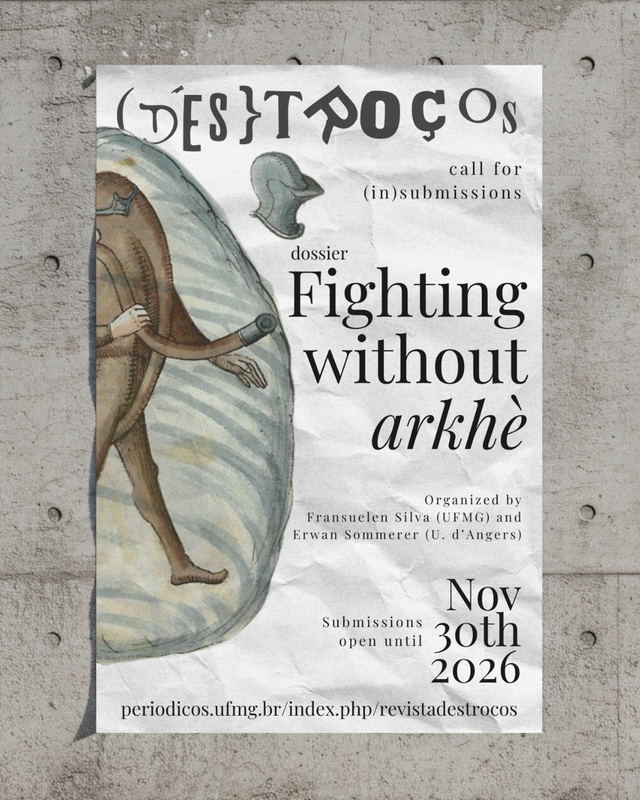
[Call for (In)submissions] - Dossier #14 – Fighting without arkhè (1srt semester 2027) | Dossier organized by Fransuelen Silva and Erwan Sommerer
How to think, mobilize and struggle when one is suspended in the void?
Reiner Schürmann, in The Principle of Anarchy, calls for breaking with the Western metaphysical tradition of arkhè, that is to say with the structure that articulates origin and command. Over time, this structure has imposed on thought and action different regimes of foundation, organizing them according to first principles, aiming to remove them from change and doubt. In this horizon, the work of deconstruction of metaphysics aims to free action from its foundation and leaves it as “suspended in the void”. The “principle of anarchy” thus designates the moment when one abandons the search for a substitute arkhè and where one assumes the paradox according to which the only principle that supports theory and practice is precisely the absence of principle.
But it is then necessary to pose the question, to which Schürmann himself devoted himself without really finding an answer, of the possibility of grasping political action through the prism of this suspension in the void. In reference to Arendt, he evokes the popular societies of the French Revolution, the Commune, the Soviets, councilism... In other words, the revolutionary in-betweens, when historical continuity is broken, when action is no longer supported by a tradition or by determinisms, and when the field of political, institutional and existential possibilities fully opens. In these moments of “caesura”, acting and doing are no longer commanded by a first foundation but become a pure presence, the principle of anarchy and the void thus breaking into the world.
An attentive reader of Schürmann, Miguel Abensour saw in it the specific moment of “insurgent democracy”: this installs itself in the interval, proper to revolutions, between previous forms, when the old order has been abolished, and the forms to come, before the State and institutions, order and discipline, are reestablished. In reference to the anarchist Gustav Landauer, he identifies in these moments a democratic aspiration and action hostile to any institutionalization and which, by “a systematic, obstinate practice of conflict” can “open to the acting of the people the widest horizon of chances”.
Here, as with other theorists, freedom passes through a post-foundational anarchism (Hakim Bey, Saul Newman, Tomás Ibáñez, Andityas Matos, etc.), through a destituent power, avoidance of the realization and reproduction of power (Giorgio Agamben) where the people appears as the name of an unappeased antagonism against the State-form. And one will also be able to understand the caesura as disidentification, when the identities imposed and hierarchized by the State, whether socio-economic, of race or of gender, are subverted or annulled, removed from the procedures that usually fix the norms of behavior and sort subjects.
But a question arises: how to occupy and hold this position today? Is it really possible to mobilize and to struggle without appealing to principles, without affirming values or identities? One can thus agree with Schürmann and Abensour while wondering what a struggle without arkhè really is, which refuses to fall into the trap of certainty and the construction of new moral or identity norms. Does such a struggle have a concrete existence or is it only an abstract concept? It thus appears that a “post-foundationalism of resistance” (to paraphrase bell hooks), notably in the framework of feminist, decolonial or anti-racist mobilizations, cannot do without a reflection on the paradoxical use, at once alienating and emancipatory, of identity.
Several paths can be opened in this sense. One can consider it necessary to reason in terms of strategic essentialism and consider that the struggle can rely on principles or deploy identities without falling into the trap of arkhè. One can also attempt to preserve fluidity and disidentification at the very heart of the struggle against exploitation and oppression, as is the case in certain queer mobilizations, by considering that only the continual subversion of identity boundaries makes it possible to counter domination. One can finally situate free acting only in sequences of radical rupture, insurrectional or riotous, which alone would be constitutive of the commune as a social relation and as a pure event (Joshua Clover). More broadly, it is necessary to question the tension that arises from the obligation to sometimes appeal to methods, thus to modes of thinking, procedures, types of relations, even to social or legal institutions, linked to the structures that one contests or that one wants to abolish.
We thus invite the submission of works that explore both the theoretical methods of struggle against the foundations that command thought and acting, and the practical methods by which it is possible to seek to free oneself from these foundations in the framework of concrete mobilizations. We wish to welcome contributions which, in their diverse expressions, experiment modes of acting without arkhè, opening a space to other forms of existence, of creation and of living together.
We also emphasize that, beyond this thematic issue, (Des)troços: Journal of Radical Thought accepts general submissions on a rolling basis, provided they align with the journal’s commitment to radical thought and its editorial line, as described at: https://periodicos.ufmg.br/index.php/revistadestrocos/about. Submissions must be made through the OJS platform, following the submission guidelines for texts (https://periodicos.ufmg.br/index.php/revistadestrocos/about/submissions). Academic degree requirements do not apply to image submissions, which will be evaluated exclusively by the editorial board. Text-based submissions will be reviewed by the editorial board and through a double-blind peer review process. Once approved, texts and images will be published in the journal’s thirteenth issue of the magazine, scheduled for release in the first semester of 2027.