Antropozoogênese da agência animal
DOI:
https://doi.org/10.53981/destrocos.v6i2.60731Palavras-chave:
antropozoogênese, agência, animal, corpoResumo
A partir do campo dos estudos animais, este artigo apresenta uma abordagem conceitual para o termo antropozoogênese e, em seguida, apresenta cuatro circunstâncias nas quais essa categoria se materializa e a chamada agência animal se torna evidente. Este objetivo busca responder: O que é uma prática de antropozoogênese? Como ela se manifesta na relação entre humanos e animais? E talvez essa prática nos possibilite falar de agência animal? As respostas a essas perguntas demonstram que a relação entre humanos e animais envolve implicitamente uma comunicação baseada na afetarem mutuamente por meio de interação gestual, muscular, visual, sensorial e emocional. Isso lhes possibilita modificar práticas e ações que, consciente ou inconscientemente, impactam os acordos e termos da relação entre ambos, desencadeando a agência animal.
Downloads
Referências
AUXILIADORA, María. Tu cuerpo animal. Revista Zarch, Zaragoza, n. 20, pp. 126-139, jun. 2023. Disponible en: https://doi.org/10.26754/ojs_zarch/zarch.2023207430. Acceso: 26 jul. 2025
BARON-COHEN, Simón. Empatía cero. Madrid: Alianza, 2012.
BEKOFF, Mark. Do Animals have feelings?: examining Empathy in Animals. Psichology and Counseling News, abr. 2019. Disponible en: https://online.uwa.edu/news/empathy-in-animals/. Acceso: 26 jul. 2025.
BEST, Steve. El surgimiento de los Estudios Críticos Animalistas: de la teoría a la práctica y hacia una educación superior por la liberación animal. Trad. Nicolás Jiménez. Argentina: Sudamérica: ICAS, 2023. Disponible en: https://www.yumpu.com/es/document/view/14273849/el-surgimiento-de-los-estudios-criticos-animalistas-dr-steve-best. Acceso: 26 jul. 2025.
CANGUILHEM, George. Lo normal y lo patológico. Trad. Ricardo Potschart. México: Siglo XXI, 2005.
DESPRET, Vinciane; PORCHER, Jocelyn. Étre Béte. París: Actes Sub, 2007.
DESPRET, Vinciane. ¿Qué dirían los animales…si les hiciéramos las preguntas correctas? Trad. Simón Puente. Buenos Aires: Ediciones Cactus, 2018.
DESPRET, Vinciane. Cuerpos, emociones, experimentación y psicología. Trad. José Carlos Loredo, Madrid: Universidad Nacional a Distancia, 2015.
DESPRET, Vinciane. El cuerpo de nuestros desvelos: figuras de la antropo-zoo-génesis. In: SÁNCHEZ-CRIADO, Tomás. Tecnogénesis: La construcción técnica de las ecologías humanas. Madrid: editorial AIBR, v. 1, pp. 229-262. 2008.
DESPRET, Vinciane. Responding Bodies and Partial Affinities in Human-Animal Worlds. Theory, Culture and Society, v. 30, pp. 51-76, 2013. Disponible en: https://journals.sagepub.com/doi/abs/10.1177/0263276413496852. Acceso: 26 jul. 2025.
GIDDENS, Anthony. Central Problems in Social Theory. Berkeley: University of California Press. 1979.
GIOVINE, Manuel Alejandro; BARRI Juan. La agencia en la sociología de Pierre Bourdieu y Anthony Giddens. Revista Estudios Sociológicos del Colegio de México, v. 42, pp. 1-18, 2024. Disponible en: https://www.scielo.org.mx/scielo.php?script=sci_arttext&pid=S2448-64422024000100115. Acceso: 28 jul. 2025.
HARAWAY, Donna. Manifiesto de las especies de compañía: perros, gentes y otredad significativa. Trad. Gabi Herczeg. Argentina: Bocavulvaria, 2017. Disponible en: https://www.bibliotecafragmentada.org/wp-content/uploads/2017/12/manifiesto-de-las-especies-final.pdf. Acceso: 28 jul. 2025.
HARAWAY, Donna. When Species Meet. Minnesota: University of Minnesota Press, 2008.
HOGGETTI, Paul. Agency, Rationality and Social Policy. Journal of Social Policy, v. 30, n. 1, pp. 37-56, 2001. Disponible en: https://www.researchgate.net/publication/259377933_Agency_Rationality_and_Social_Policy. Acceso: 28 jul. 2025.
LARSON, Greger; FULLER, Dorian Q . The Evolution of Animal Domestication. The AnnualReview of Ecology, Evolution, and Systematics, v. 45, pp. 115-136, 2014. Disponible en: https://www.annualreviews.org/doi/abs/10.1146/annurev-ecolsys-110512-135813. Acceso: 28 jul. 2025.
LOBATO Vila, Irene. ¿Por qué juegan los animales? Blog All you need is Biology. 2019. Disponible es: https://allyouneedisbiology.wordpress.com/2016/04/09/juego-en-animales/#:~:text=Seg%C3%BAn%20la%20psicolog%C3%ADa%20y%20la,la%20supervivencia%20(o%20fitness)%20del. Acceso: 28 jul. 2025.
OJEDA MARTÍNEZ, Rosa Icela. Reflexiones e instituciones sobre la empatía en los animales: una perspectiva fenomenológica. Revista Latinoamericana de Estudios Críticos Animales, año IX, v. II, pp. 269-286, 2022. Disponible en: https://revistaleca.org/index.php/leca/article/view/391. Acceso: 28 jul. 2025.
PORCHER, Jocelyne. Vivir con los animales: contra la ganadería industrial y la liberación animal. Trad. Jesús García. Alicante: Colección El salmón, 2021.
RUSSELL, Nerisa. Social Zooarchaeology: Humans and Animals in Prehistor. Cambridge: Cambridge University Press, 2012.
SANTANA RIVERA, Javier; AMADO LÓPEZ, Adela. Relación de niveles de empatía y la convivencia con animales de compañía. Apuntes de Psicología, v. 35, n. 3, pp. 195-201, 2017. Disponible en: https://idus.us.es/items/0197c8a9-6fd0-43ca-a50c-b819afa04fc8. Acceso: 27 jul. 2025.
SINGER, Peter. Animal Liberation. New York: New York Review of Books, 1975.
URIBE Mendoza, Blanca. La domesticación animal. Apuntes sobre su origen e impacto en el orden social y biológico. Revista Latinoamericana de Estudios Críticos Animales, año VIII, n. 1, pp. 423-442, 2021. Disponible en: https://revistaleca.org/index.php/leca/article/view/83. Acceso: 27 jul. 2025.
WAAL, Frans de. Evidence Implies thar Animals Feel Empathy. Scientific American. Edición especial, sep. 2015. Disponible en: https://www.scientificamerican.com/article/evidence-implies-that-animals-feel-empathy/. Acceso: 27 jul. 2025.
WAAL, Frans de. La edad de la empatía: ¿Somos altruistas por naturaleza? Trad. Ambrosio García Leal, Buenos Aires: Tusquets Editores, 2022.
ZEDER, Melinda. The Domestication of Animals. Journal of Anthropological Research, v. 68, n. 2, pp. 161-190, 2012. Disponible en: https://www.journals.uchicago.edu/doi/10.3998/jar.0521004.0068.201. Acceso: 27 jul. 2025.
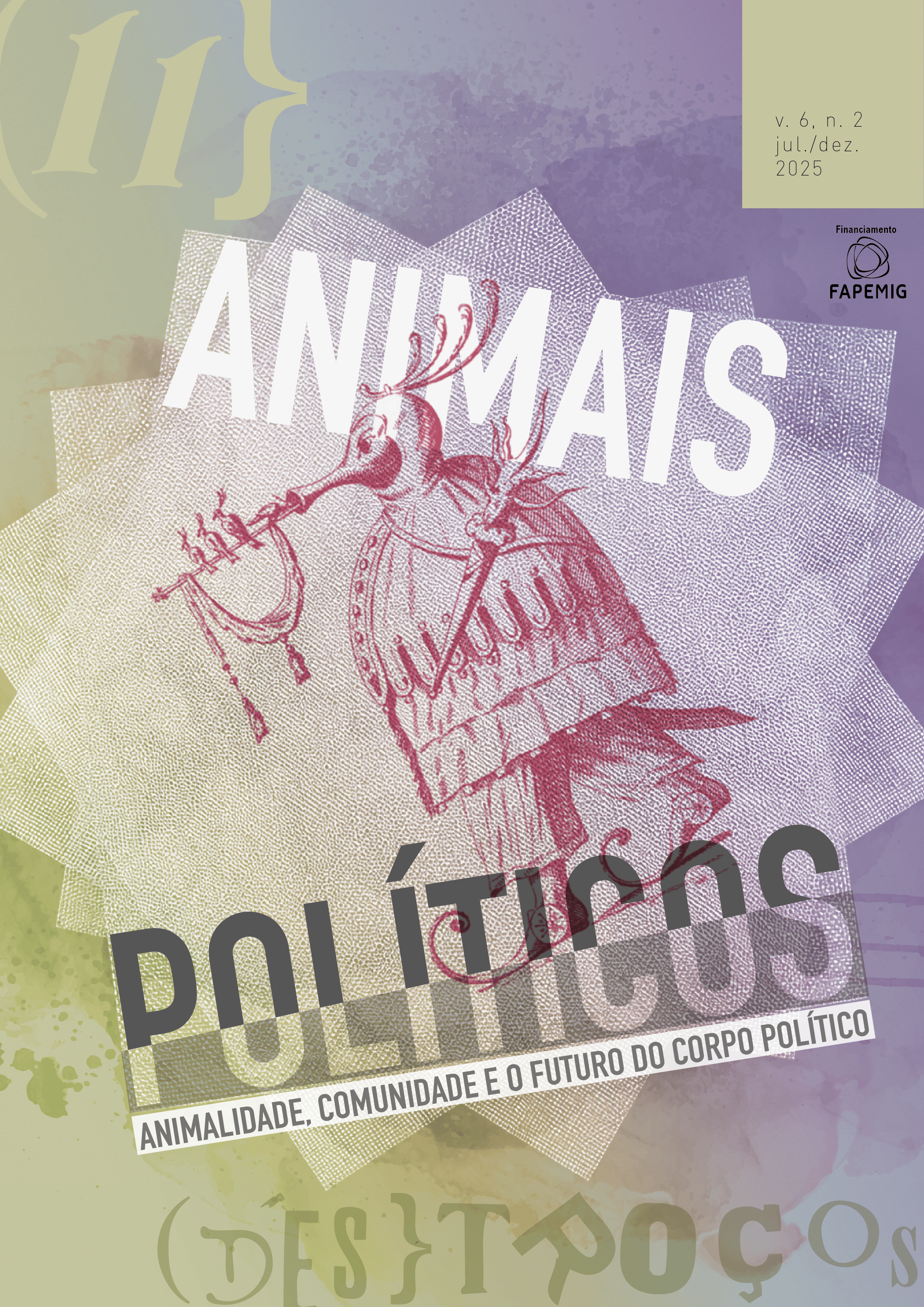
Downloads
Publicado
Edição
Seção
Licença
Copyright (c) 2025 Blanca Irais Uribe Mendoza

Este trabalho está licenciado sob uma licença Creative Commons Attribution 4.0 International License.
Como Citar