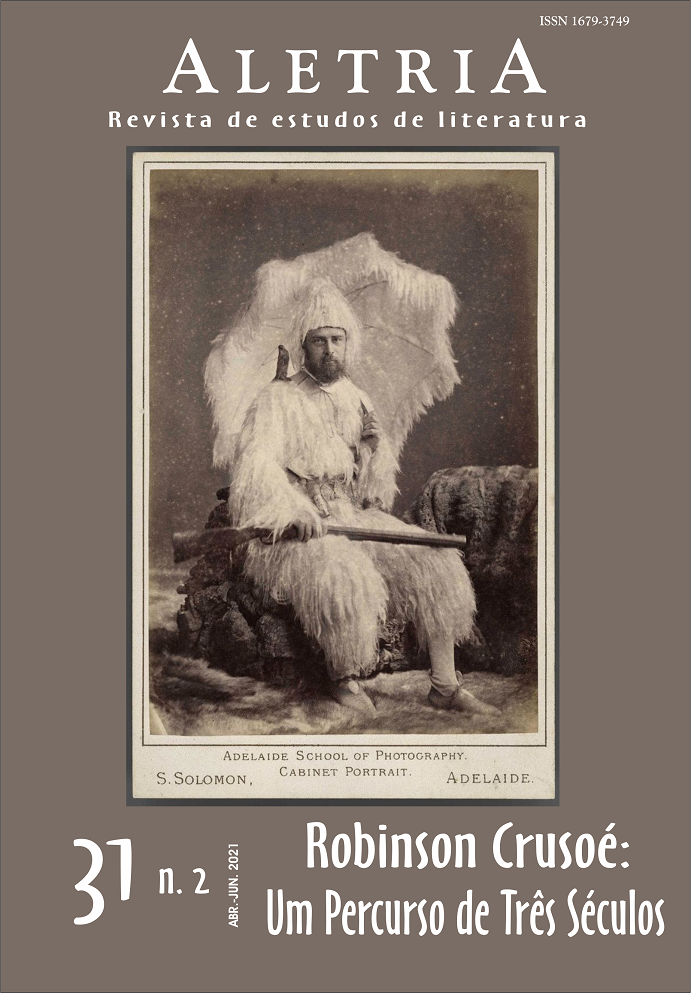
As ficções editoriais e narrativas de Robinson Crusoé
DOI:
https://doi.org/10.35699/2317-2096.2021.25822Palavras-chave:
ficção, narração , Robinson CrusoéResumo
Este artigo analisa os artifícios narrativos que caracterizam a trama de Robinson Crusoé, romance publicado em 1719 e considerado um dos textos fundadores da ficção moderna. O exame das estratégias de dissimulação da autoria, que considera a recepção setecentista das três obras relacionadas ao personagem, permite investigar as relações entre narração e ficcionalidade nos textos escritos por Daniel Defoe. A análise destes elementos constitutivos do romance como gênero letrado relacionado ao livro sugere uma história da literatura interessada nos efeitos produzidos pelos dispositivos editoriais e nas diferentes estratégias de atribuição de sentido potencializadas pela ampliação do escopo da crítica a partir do século XVIII.
Downloads
Referências
BAPTISTA, Abel Barros. Autobibliografias: solicitação do livro na ficção de Machado de Assis. Lisboa: Relógio D’água, 1998.
BLAIR, Hugh. Lectures on Rhetoric and Belles Lettres. London: Gale ECCO, 2010. v. II.
BULLARD, Rebecca. Politics, History, and the Robinson Crusoe Story. In: RICHETTI, John (ed.). The Cambridge Companion to “Robinson Crusoe”. New York: Cambridge University Press, 2018. p. 84-98. DOI: https://doi.org/10.1017/9781107338586.007.
BUNIA, Remigius. Uma história moral da ficção. In: GALLE, Helmut P. E.; PEREZ, Juliana P.; PEREIRA, Valéria S. (org.). Ficcionalidade: uma prática cultural e seus contextos. São Paulo: FFLCH, 2018. p. 95-109.
CURTIUS, Ernst Robert. Literatura europeia e Idade Média latina. Tradução de Teodoro Cabral e Paulo Rónai. São Paulo: Editora da Universidade de São Paulo, 2013.
DEFOE, Daniel. Robinson Crusoe. New York: Oxford University Press, 2007. DOI: https://doi.org/10.1093/owc/9780199553976.001.0001.
DEFOE, Daniel. Robinson Crusoé. Tradução de Sergio Flaksman. São Paulo: Penguin Classics Companhia das Letras, 2011.
DEFOE, Daniel. Serious Reflections During the Life and Surprising Adventures of Robinson Crusoe: With his Vision of the Angelick World. London: W. Taylor, 1720.
DEFOE, Daniel. The Farther Adventures of Robinson Crusoe. Maryland: Wildside Press, 2004.
DEFOE, Daniel. The Review, v. VI, n. 129, 2 Feb. 1710.
GENETTE, Gérard. Paratextos editoriais. Tradução de Álvaro Faleiros. Cotia: Ateliê Editorial, 2009.
GILDON, Charles. The Life and Strange Surprizing Adventures of Mr D–––– De F––. London: J. Roberts, 1719.
GRIFFIN, Dustin. The social World of Authorship 1660-1714. In: RICHETTI, John (ed.). The Cambridge History of English Literature, 1660-1780. Cambridge: Cambridge University Press, 2005. p. 37-60. DOI: https://doi.org/10.1017/CHOL9780521781442.004.
HUNTER, J. Paul. Defoe and Poetic Tradition. In: RICHETTI, John (ed.). The Cambridge Companion to Daniel Defoe. New York: Cambridge University Press, 2008. p. 216-230. DOI: https://doi.org/10.1017/CCOL9780521858403.013.
HUNTER, J. Paul. Genre, Nature, Robinson Crusoe. In: RICHETTI, John (ed.). The Cambridge Companion to “Robinson Crusoe”. New York: Cambridge University Press, 2018. p. 3-15. DOI: https://doi.org/10.1017/9781107338586.002.
KELNER, Thomas. Robinson Crusoe: Daniel Defoe. Edição e introdução de Thomas Keymer. Notas de Thomas Keymer e James Kelly. New York: Oxford University Press, 2007.
KONRAD, Eva-Maria. “The Poet, He Nothing Affirms, and Therefore Never Lieth”? An Analysis of Editorial Fiction. DIEGESIS, Wuppertal, v. 4, n. 1, p. 1-17, 2015.
MELTON, James Van Horn. The Rise of the Public in Enlightenment Europe. Cambridge: Cambridge University Press, 2004.
NIXON, Cheryl L. (ed.). Novel Definitions: An Anthology of Commentary on the Novel, 1688-1815. Peterborough: Broadview Press, 2009.
NOVAK, Maximilian E. The Deplorable Daniel Defoe: His Supposed Ignorance, Immorality, and Lack of Conscious Artistry. Digital Defoe: Studies in Defoe & His Contemporaries, [S. l.], n. 10.1, p. 1-17, fall 2018.
RALEIGH, Walter. Johnson on Shakespeare. London: Oxford University Press, 1908.
RODGERS, Pat (ed.). Daniel Defoe: The Critical Heritage. London: Routledge, 1995.
SEIDEL, Kevin. Robinson Crusoe as Defoe’s Theory of Fiction. Novel: A Forum on Fiction, North Carolina, v. 44, n. 2, p. 165-185, summer 2011. DOI: https://doi.org/10.1215/00295132-1260941.
SEIDEL, Michael. Robinson Crusoe: Varieties of Fictional Experience. In: RICHETTI, John (ed.). The Cambridge Companion to Daniel Defoe. New York: Cambridge University Press, 2008. p. 182-199. DOI: https://doi.org/10.1017/CCOL9780521858403.011.
SPACKS, Patricia Meyer. The 1740s. In: ARATA, Stephen; HALEY, Madigan; HUNTER, J. Paul; WICKE, Jennifer (ed.). A Companion to English Novel. Oxford: Wiley-Blackwell, 2015. p. 3-17. DOI: https://doi.org/10.1002/9781118607251.ch1.
WATT, Ian. A ascensão do romance. Tradução de Hildegard Feist. São Paulo: Companhia das Letras, 2010.
WELLEK, René. História da crítica moderna. Tradução de Lívio Xavier. São Paulo: Editora Herder, 1967.
WOLF, Werner. Is Aesthetic Illusion ›illusion référentielle‹? ›Immersion‹ in (Narrative) Representations and Its Relationship to Fictionality and Factuality. Journal of Literary Theory, [S.l.], v. 2, n. 1, p. 99-126, 2008. DOI: https://doi.org/10.1515/JLT.2008.007.
Downloads
Publicado
Edição
Seção
Licença
Copyright (c) 2021 Lainister de Oliveira Esteves (Autor)

Este trabalho está licenciado sob uma licença Creative Commons Attribution 4.0 International License.
Autores que publicam nesta revista concordam com os seguintes termos:Autores mantém os direitos autorais e concedem à revista o direito de primeira publicação, com o trabalho simultaneamente licenciado sob a Licença Creative Commons Attribution que permite o compartilhamento do trabalho com reconhecimento da autoria e publicação inicial nesta revista.Autores têm autorização para assumir contratos adicionais separadamente, para distribuição não-exclusiva da versão do trabalho publicada nesta revista (ex.: publicar em repositório institucional ou como capítulo de livro), com reconhecimento de autoria e publicação inicial nesta revista.Autores têm permissão e são estimulados a publicar e distribuir seu trabalho online (ex.: em repositórios institucionais ou na sua página pessoal) a qualquer ponto antes ou durante o processo editorial, já que isso pode gerar alterações produtivas, bem como aumentar o impacto e a citação do trabalho publicado (Veja The Effect of Open Access).
Como Citar