
What if the past is a simulation?
DOI:
https://doi.org/10.31239/1049p630Keywords:
Archaeology, Cyberarchaeology, Archaeological simulation, ArchaeogamingAbstract
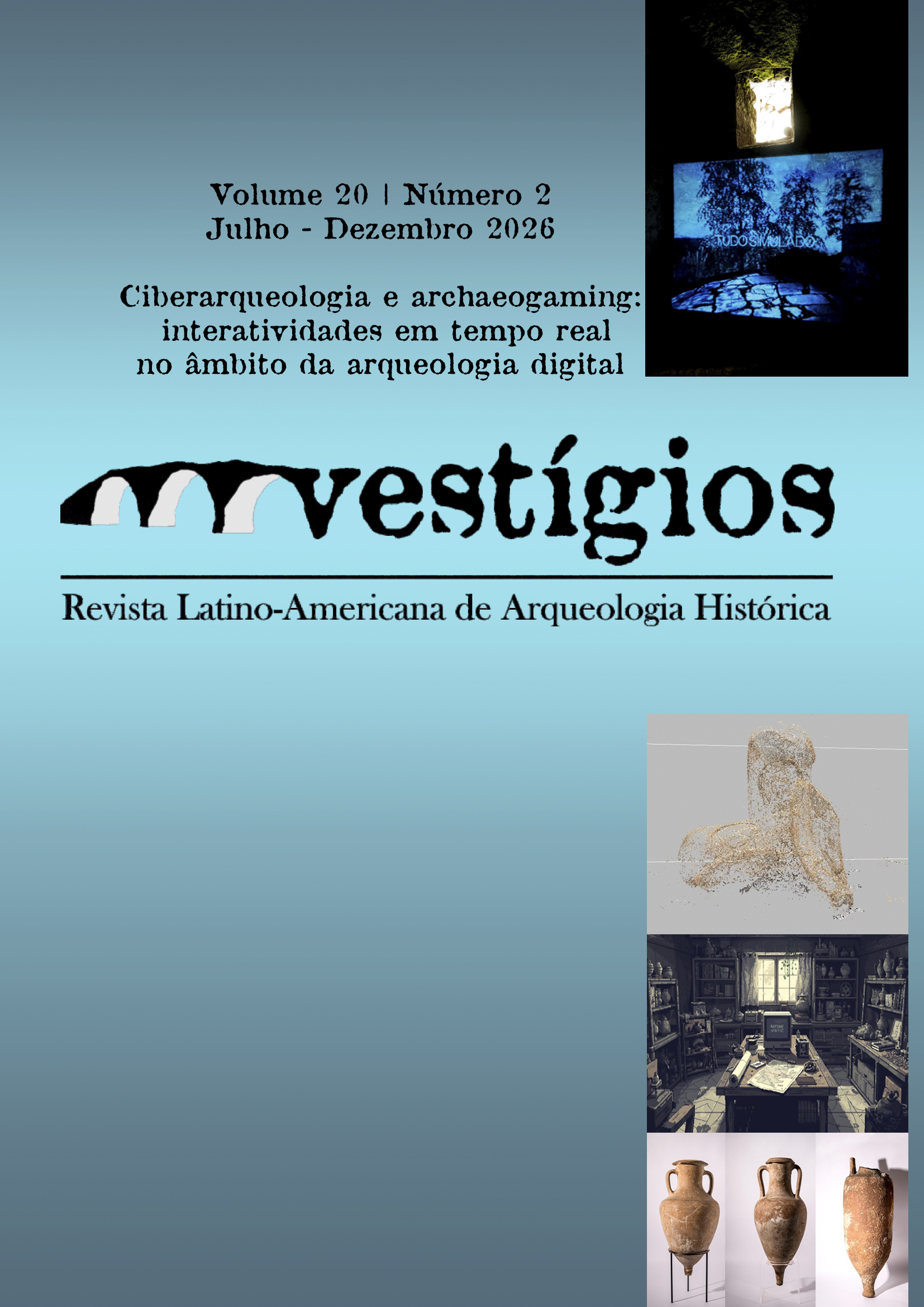
This article proposes a critical reading of archaeological simulation as a constitutive condition of knowledge about the past. Its central hypothesis is straightforward: the archaeological past never reaches the present as immediate presence; it arrives through traces, gaps, classifications, analogies, images, narratives, technologies, and disciplinary assumptions. In this sense, archaeology has always worked through forms of simulation, long before the emergence of digital environments. Plans, stratigraphic sections, typologies, maps, reconstructions, museum displays, and historical narratives organize possible worlds from material fragments. Cyberarchaeology does not inaugurate this condition; it makes it visible, navigable, and critically debatable. Drawing on the Romariz 3D case study and the installation Archaeological Simulation, the article analyzes the passage from the archaeological trace to the digital environment, distinguishing among the three-dimensional model, reconstruction, simulation, virtual reality, and experience. In dialogue with cyberarchaeology, archaeogaming, post-processual archaeological theory, Foucauldian archival critique, and the principles of transparency in virtual archaeology, it argues that archaeological simulation matters less as a final image of the past than as a space of interpretive dispute. Its contribution lies in exposing choices, uncertainties, technical assumptions, and regimes of visibility. To simulate the past, in this sense, is not to escape materiality, but to make explicit the conditions through which materiality becomes intelligible, experienceable, and socially recognized.
References
Baudrillard, J. (1998). Simulacra and simulation. Em Poster, M. (ed.). Selected writings (pp. 166-184). Redwood City: Stanford University Press.
Bentkowska-Kafel, A., Denard, H., & Baker, D. (eds.). (2012). Paradata and transparency in virtual heritage. Farnham: Ashgate. Disponível em: <https://www.researchgate.net/publication/287270234_Paradata_and_transparency_in_virtual_heritage>. [cons. 15 mar. 2026].
Bostrom, N. (2003). Are you living in a computer simulation? The Philosophical Quarterly, 53(211), 243-255. DOI: 10.1111/1467-9213.00309.
Central Intelligence Agency. (1995). Stargate project: Collection of declassified documents. Washington, D.C. Disponível em: <https://www.cia.gov/readingroom/collection/stargate>. [cons. 15 mar. 2026].
Champion, E. (2015). Critical gaming: interactive history and virtual heritage. London: Routledge.
Champion, E. M. (2021). Preserving authenticity in virtual heritage. Em Champion, E. M. (ed.). Virtual heritage: a guide (pp. 129-137). London: Ubiquity Press. DOI: 10.5334/bck.l.
Denard, H. (ed.). (2009). The London Charter for the computer-based visualisation of cultural heritage. Version 2.1. Disponível em: <http://www.londoncharter.org>. [cons. 15 mar. 2026].
Denard, H. (2013). Implementing best practice in cultural heritage visualisation: The London Charter. Em Corsi, C., Slapšak, B., & Vermeulen, F. (eds.). Good practice in archaeological diagnostics (pp. 255-268). New York: Springer.
Forte, M. (ed.). (2010). Cyber-archaeology. Oxford: Archaeopress.
Forte, M. (2011). Cyber-archaeology: notes on the simulation of the past. Virtual Archaeology Review, 2(4), 7-18. DOI: 10.4995/var.2011.4543.
Forte, M. (2015). Cyber archaeology: a post-virtual perspective. Em Goldberg, D. T., & Svensson, P. (eds.). Between humanities and the digital (pp. 295-310). Cambridge: MIT Press.
Foucault, M. (2008) [1969]. A arqueologia do saber. Rio de Janeiro: Forense Universitária.
Giannachi, G., Kaye, N., & Shanks, M. (eds.). (2012). Archaeologies of presence: art, performance and the persistence of being. London: Routledge.
Gibson, J. J. (1979). The ecological approach to visual perception. Boston: Houghton Mifflin.
Hodder, I. (1986). Reading the past: current approaches to interpretation in archaeology. Cambridge: Cambridge University Press.
Huvila, I. (2012). The unbearable complexity of documenting intellectual processes: Paradata and virtual cultural heritage visualisation. Human IT, 12(1), 97-110.
Hyman, R. (1995). Evaluation of program on anomalous mental phenomena. Washington, D.C.: Central Intelligence Agency.
ICOMOS. (2017). The Seville Principles: International Principles of Virtual Archaeology. Ratified by the 19th ICOMOS General Assembly. New Delhi.
Jorge, V. O. (2003). A irrequietude das pedras: reflexões e experiências de um arqueólogo. Porto: Edições Afrontamento.
López-Menchero Bendicho, V. M., & Grande, A. (2011). The principles of the Seville Charter. Proceedings of the CIPA 2011 Symposium. Prague: Czech Technical University in Prague.
Marini, I., Neto, E., & Perani, L. (2017). As mecânicas do divertimento: uma análise de affordances em games de simulação de parques de diversão. Metamorfose: Arte, Ciência e Tecnologia, 2(1), 188-207.
May, E. C., & Marwaha, S. B. (eds.). (2018). The Star Gate archives: Reports of the United States government sponsored PSI program, 1972-1995. Jefferson: McFarland.
Morgan, C. (2009). (Re)building Çatalhöyük: changing virtual reality in archaeology. Archaeologies, 5(3), 468-487.
Morgan, C. (2019). Avatars, monsters, and machines: a cyborg archaeology. European Journal of Archaeology, 22(3), 324-337.
Mullen, G., & Davidenko, N. (2021). Time compression in virtual reality. Timing & Time Perception, 9(4), 377-392.
Oliveira, E. V., & Galhano, F. (1992). Arquitectura tradicional portuguesa. Lisboa: Dom Quixote.
Oliveira, E. V., Galhano, F., & Pereira, B. (1969). Construções primitivas em Portugal. Lisboa: Instituto de Alta Cultura.
OpenAI. (2025). Announcing the Stargate Project. 21 de Janeiro de 2025. Disponível em: <https://openai.com/index/announcing-the-stargate-project/>. [cons. 15 mar. 2026].
Palmer, R. E. (2018). Hermenêutica. Lisboa: Edições 70.
Reinhard, A. (2018). Archaeogaming: an introduction to archaeology in and of video games. New York: Berghahn Books.
Remondino, F., & Campana, S. (eds.). (2014). 3D recording and modelling in archaeology and cultural heritage: theory and best practices. Oxford: Archaeopress.
Silva, P. (2013). A informática e multimédia aplicadas à investigação arqueológica: a modelação 3D do Castro de Romariz e a sua aplicação numa plataforma de jogo. Dissertação (Mestrado). Universidade do Porto, Faculdade de Letras, Porto.
Silva, P. (2020). Ensaio sobre a (re)construção arqueológica como performance. Al-Madan Online, 1(23), 114-118.
Silva, P. (2021). Arqueologia e simulação: contributo para um debate sobre a realidade. Antrope, 13, 239-251. Disponível em: <https://www.academia.edu/53111772/Arqueologia_e_Simula%C3%A7%C3%A3o_contributo_para_um_debate_sobre_a_realidade>. [cons. 15 mar. 2026].
Silva, P. (2022). The archaeological simulation: blending times and time travel through metaverse? Em Griffin, H. (ed.). (In)tangible heritage(s): a conference on design, culture and technology: past, present and future (pp. 4-9). AMPS Proceedings Series 29.2. Canterbury, University of Kent.
Silva, P. (2023). Guia da exposição: artefactos do Descarte: evento performativo de arte-arqueologia. Disponível em: <https://www.academia.edu/109942782/Poster_Artifacts_of_Discard_Art_Archaeology_Performative_Event_>. [cons. 14 mar. 2026].
Silva, P. (2024). Simulação arqueológica: paisagens digitais do povoado proto-histórico de Romariz. Seattle: Amazon Kindle Direct Publishing.
Tarkovsky, A. (1987). Sculpting in time: reflections on the cinema. Austin: University of Texas Press.
Utts, J. (1995). An assessment of the evidence for psychic functioning. Washington, D.C.: Central Intelligence Agency. Disponível em: <https://www.cia.gov/readingroom/docs/CIA-RDP96-00791R000200070001-9.pdf>. [cons. 14 mar. 2026].
Varela, F. J., Thompson, E., & Rosch, E. (1991). The embodied mind: cognitive science and human experience. Cambridge: MIT Press.
Vitrúvio (2006). Tratado de arquitectura. Lisboa: IST Press.
Wilde, P. (2023). Posthuman gaming: avatars, gamers, and entangled subjectivities. London: Routledge.
Wolny, R. (2017). Hyperreality and simulacrum: Jean Baudrillard and European postmodernism. European Journal of Interdisciplinary Studies, 3(3), 75-79.
Downloads
Published
Issue
Section
License
Copyright (c) 2026 Pedro Da Silva

This work is licensed under a Creative Commons Attribution-NonCommercial 4.0 International License.

O trabalho Vestígios - Revista Latino-Americana de Arqueologia Histórica de https://periodicos.ufmg.br/index.php/vestigios/index está licenciado com uma Licença Creative Commons - Atribuição-NãoComercial 4.0 Internacional.
Baseado no trabalho disponível em https://periodicos.ufmg.br/index.php/vestigios/index.
Podem estar disponíveis autorizações adicionais às concedidas no âmbito desta licença em https://periodicos.ufmg.br/index.php/vestigios/index.
