
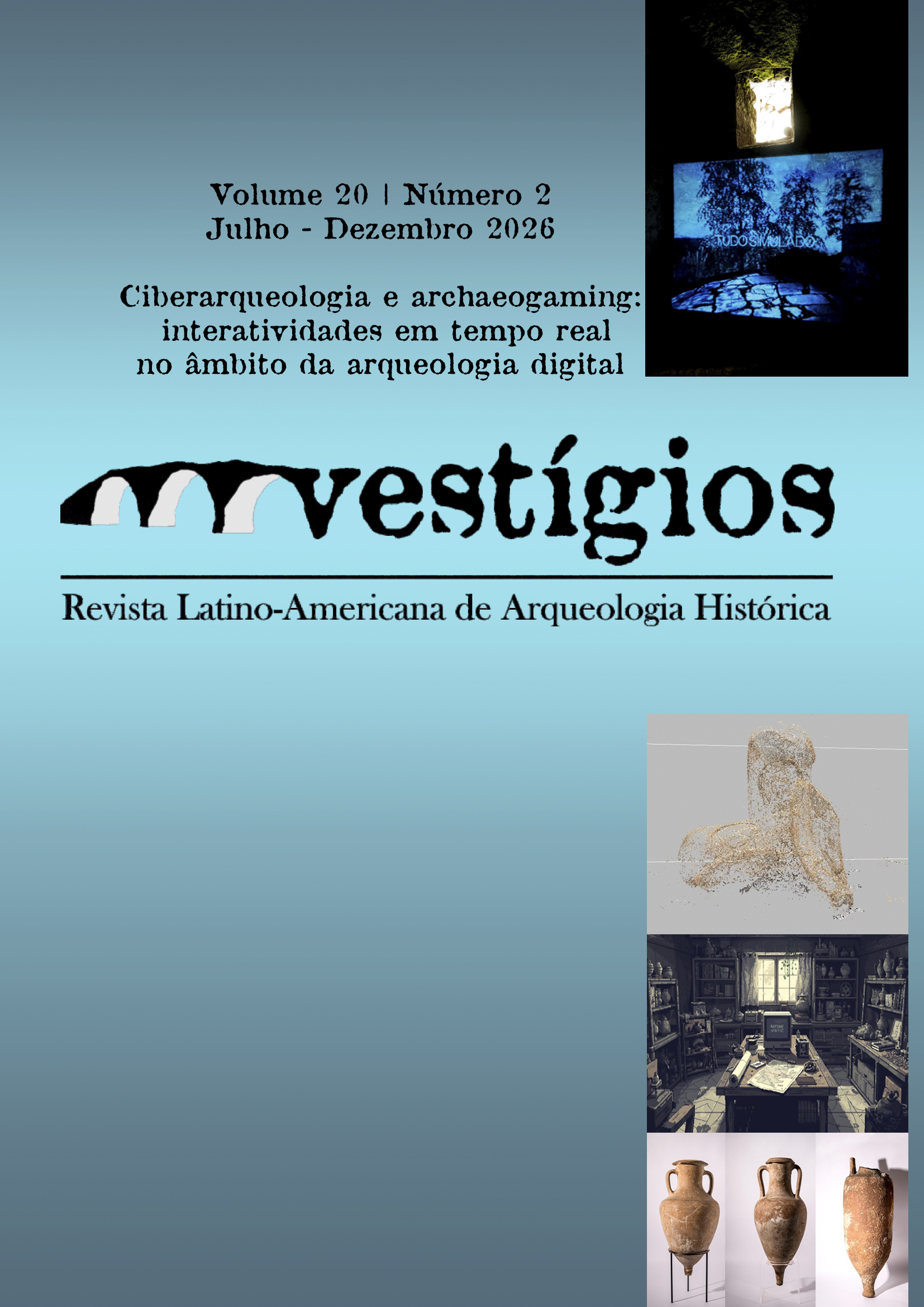
Comparative analysis of 3D digitization technologies applied to the MAE-USP amphora collection
DOI:
https://doi.org/10.31239/amxy2968Keywords:
3D Digitization, Photogrammetry, 3D Scanning, Amphorae, Digital ArchaeologyAbstract
This article presents a comparative evaluation of three-dimensional digitization technologies applied to the study of amphorae from the collection of the Museum of Archaeology and Ethnology of the University of São Paulo (MAE-USP), within the framework of the project “Multimodal Analysis of Amphorae from MAE-USP: 3D Documentation and Archaeometric Investigation.” The study examines three complete amphorae and five stamped handle fragments, digitized using active-sensor 3D scanning (Artec Space Spider and NextEngine) and digital photogrammetry, with data processed using Agisoft Metashape and Artec Studio. The analysis is based on quantitative criteria – such as mesh density, acquisition and processing time, and inter-model geometric deviation – and qualitative criteria related to visual fidelity, surface resolution, and archaeological applicability. The results indicate that all approaches produce geometrically consistent models at the submillimeter scale, suitable for morphological and typological analyses. However, significant differences are observed in sampling density, microtopographic preservation, and texture quality. Active-sensor methods demonstrate higher geometric accuracy and better recording of fine details, whereas photogrammetry provides superior chromatic homogeneity and visual resolution, albeit with a tendency toward surface smoothing and increased mesh faceting under certain conditions. Additionally, relevant contrasts are observed in operational efficiency and workflow robustness, particularly regarding the degree of automation and the need for manual intervention. It is concluded that technological choice is not merely instrumental but conditions the nature of the data produced and, consequently, the range of analytical and interpretative possibilities, reinforcing the need for explicit methodological criteria in digital archaeology.
References
Barreau, J.-B., Bruniaux, G., Petit, E., Petit, Q., Bernard, Y., Gaugne, R., & Gouranton, V. (2014a). Photogrammetry based study of ceramics fragments. International Journal of Heritage in the Digital Era, 3(4), 643-656.
Barreau, J.-B., Nicolas, T., Bruniaux, G., Petit, E., Petit, Q., Bernard, Y., Gaugne, R., & Gouranton, V. (2014b). Ceramics fragments digitization by photogrammetry, reconstructions and applications. International Conference on Culturage Heritage, EuroMed. Chipre: Universidade de Tecnologia de Chipre.
Batistela, G. C., Moraes, C. A. da C., & Miamoto, P. (2017). Comparação entre cinco sistemas de digitalização 3D por fotogrametria aplicados à Antropologia Forense e Odontologia Legal. Revista Brasileira de Odontologia Legal, 4(3), 24-33.
Bazzurri, F., & Picardello, M. A. (2018). Optimization techniques for photogrammetry applied to cultural heritage and the action of transformation groups. Em De Paolis, L. T. & Bourdot, P. (eds.). Augmented Reality, Virtual Reality, and Computer Graphics (pp. 332-348). Cham: Springer.
Bezzi, L., Bezzi, A., Gietl, R., Moraes, C. A. da C., Naponiello, G., Airò, S., Putzer, A., & Silvestri, E. (2024). Digital twins of archaeological finds: open Source technologies applied to 3D scanning. Archeologia e Calcolatori, 35(2), 203-214.
Coutinho, Y. B. (2025). Desenvolvimento e aplicação de um protocolo de fotogrametria em um contexto laboratorial de acervos arqueológicos. Trabalho de conclusão de curso. Universidade Federal do Rio Grande, Rio Grande.
Di Angelo, L., Di Stefano, P., & Guardiani, E. (2022). Preview of computer-based methods for classification and reconstruction of 3D high-density scanned archaeological pottery. Journal of Cultural Heritage, 56, 10-24.
Drap, P., Seinturier, J., & Long, L. (2003). Archaeological 3D Modelling using digital photogrammetry and Expert System. The case study of Etruscan amphorae. Proceedings of the VIth Infographie Interactive et Intelligence Artificielle International Conference. Limoges: Universidade de Limoges.
Drap, P., Sgrenzaroli, M., Canciani, M., Cannata, G., & Seinturier, J. (2003). Laser Scanning and close range photogrammetry: Towards a single measuring tool dedicated to architecture and archaeology. CIPA XIXth International Symposium. Antalya: Universidade Técnica de Istambul.
Duelis Viana, C. (2021). Fotogrametria digital multi-escala para aquisição de dados estruturais. Dissertação (Doutorado). Universidade de São Paulo, São Paulo.
Falkingham, P. L. (2012). Acquisition of high resolution three-dimensional models using free, open-source, photogrammetric software. Palaeontologia Electronica, 15(1), 1-15.
Felícisimo, Á. M., & Polo, M.-E. (2022). Measurement and control of colour fidelity in scanned 3D models for heritage conservation. Journal of Cultural Heritage, 56, 159-166.
Fleming, M. I. D., Abreu, T. B. A. de, Teixeira-Bastos, M., Martire, A. da S., & Gregori, A. M. (2017). A importância das novas tecnologias para a arqueologia e suas possibilidades de uso. A impressão 3D e os projetos do LARP. Vestígios - Revista Latino-Americana de Arqueologia Histórica, 11(1), 55-79.
Forte, M. (ed.). (2010). Cyber-Archaeology. Oxford: British Archaeological Reports.
Forte, M., Dell’Unto, N., Issavi, J., Onsurez, L., & Lercari, N. (2012). 3D Archaeology at Çatalhöyük. International Journal of Heritage in the Digital Era, 1(3), 351-378.
Forte, M., & Siliotti, A. (eds.). (1997). Virtual archaeology: re-creating Ancient Worlds. Nova Iorque: Abrams.
Franco, G. G., & Naime, A. (2021). Structure from Motion (SFM) – Uma breve revisão histórica, aplicações nas geociências e perspectivas futuras. Anuário do Instituto de Geociências, 44(40853), 1-10.
Frandanisa, G. R. B. (2026). Restauro virtuale delle edicole-naiskoi e dei segnacoli dipinti di Lilibeo: Metodologie, applicazioni e risultati. Em Cangemi, M. & Schepis, L. (eds.). Archeologia virtuale all’Universita’ di Palermo: Le attività di didattica e ricerca dell’insegnamento di Archeologia Virtuale (2022-2025) (pp. 65-80). Palermo: Palermo University Press.
Funari, P. P. A. (2001). MAE-USP amphora collection: vessels and inscriptions. Revista do Museu de Arqueologia e Etnologia, 11, 275-282.
Guedes, C. M. (2016). Tecnologias de processamento fotogramétrico e restauro digital como ferramentas de preservação e conservação do patrimônio arqueológico: um estudo de caso do contexto brasileiro. Em Campos, G. do N. & Granato, M. (orgs.). Anais do 4o Seminário Preservação de Patrimônio Arqueológico (pp. 253-267). Rio de Janeiro: Museu de Astronomia e Ciências Afins.
Guidi, G., Remondino, F., Morlando, G., Del Mastio, A., Uccheddu, F., & Pelagotti, A. (2007). Performances evaluation of a low cost active sensor for cultural heritage documentation. 8th Conference on Optical 3D Measurement Techniques (pp. 59-69). Zurique: Instituto Federal de Tecnologia de Zurique.
Hoffmeister, D., Zellmann, S., Kindermann, K., Pastoors, A., Lang, U., Bubenzer, O., Weniger, G.-C., & Bareth, G. (2014). Geoarchaeological site documentation and analysis of 3D data derived by terrestrial laser scanning. ISPRS Annals of the Photogrammetry, Remote Sensing and Spatial Information Sciences, Volume II-5, 173-179.
Kraus, K. (2007). Photogrammetry. Geometry from Images and Laser Scans. Berlim: Walter de Gruyter.
Kuzminsky, S. C., & Gardiner, M. S. (2012). Three-dimensional laser scanning: potential uses for museum conservation and scientific research. Journal of Archaeological Science, 39, 2744-2751.
Lauro, V., & Lombardo, V. (2023). The cataloging and conservation of digital survey in archaeology: a photogrammetry protocol in the context of digital data curation. Heritage, 6, 3113-3136. DOI: 10.3390/heritage6030166.
Limoncelli, M. (2012). Il restauro virtuale in archeologia. Roma: Carocci editore.
Limoncelli, M., & Schepis, L. (2024). Virtual restoration 3.1. Architecture. Principles and methods for virtual archaeological reconstruction of ancient monuments. Roma: L’Erma Di Bretschneider.
Luhmann, T., Robson, S., Kyle, S., & Boehm, J. (2020). Close-range photogrammetry and 3D imaging. Berlim: De Gruyter.
Magalhães, A. J. F. de, Berredo, A. L., & Gaspar, M. (2018). De volta ao passado: a aplicação da fotogrametria para registro arqueológico 3D. Revista de Arqueologia, 31(1), 185-207.
Martire, A. da S. (2017). Ciberarqueologia em Vipasca: o uso de tecnologias para a reconstrução-simulação interativa arqueológica. Dissertação (Doutorado). Universidade de São Paulo, São Paulo.
Martire, A. da S., Pina, A. D. de V., Jordani, A. B., Ávila, C. de, Moura, C. H. de, Branco, L. O. de A., Cruz, M. M., Cafagne, T. P., & Carvalho, V. M. (2024). Cultura material e digital em diálogo. São Paulo: Museu de Arqueologia e Etnologia/USP.
Martire, A. da S., & Porto, V. C. (orgs.). (2022). (Des)construindo arqueologias digitais. São Paulo: Museu de Arqueologia e Etnologia/USP.
Moraes Wichers, C. A. de, Zanettini, P., & Tega, G. (2017). Entre seres e coisas: a aplicação de tecnologias 3D como ponte entre patrimônio arqueológico e sociedade. Vestígios - Revista Latino-Americana de Arqueologia Histórica, 11(1), 80-106.
Paukkonen, N. (2023). Towards a mobile 3D documentation solution. Video-based photogrammetry and iPhone 12 Pro as fieldwork documentation tools. Journal of Computer Applications in Archaeology, 6(1), 143-154. DOI: 10.5334/%20jcaa.135.
Paukkonen, N. (2024). This is how we do it in the field: photogrammetry as a fieldwork documentation tool on a Finnish archaeological project in Greece. The Photogrammetric Journal of Finland, 29(1), 1-15. DOI: 10.17690/024291.1.
Perrone Jr., R. V., & Williams, J. L. (2019). Dimensional accuracy and repeatability of the NextEngine laser scanner for use in osteology and forensic anthropology. Journal of Archaeological Science: Reports, 25, 308-319.
Pina, A. D. de V. (2025). Etnoarchaeogaming: o desenvolvimento e a aplicação de jogos que conectam Arqueologia, patrimônio e almas. Dissertação (Doutorado). Universidade de São Paulo, São Paulo.
Porter, S. T., Roussel, M., & Soressi, M. (2016). A simple photogrammetry rig for the reliable creation of 3D artifact models in the field lithic examples from the Early Upper Paleolithic Sequence of Les Cottés (France). Advances in Archaeological Practice, 4(1), 71-86.
Remondino, F. (2011). Heritage recording and 3D modeling with photogrammetry and 3D scanning. Remote Sensing, 3, 1104-1138. DOI: 10.3390/rs3061104.
Remondino, F., & Campana, S. (2014). 3D recording and modelling in archaeology and cultural heritage. Theory and best practices (V. 2598). Oxford: British Archaeological Reports International Series.
Remondino, F., & El-Hakim, S. (2006). Image‐based 3D modelling: a review. The Photogrammetric Record, 21(115), 269-291.
Robinson, M. G. P. (2024). Photogrammetry for archaeological objects. A manual. Sydney: Sydney University Press.
Rodríguez González, E., Carbonell Pastor, S., & Casals, J. R. (2019). Lost colours: photogrammetry, image analysis using the DStretch plugin, and 3-D modelling of post-firing painted pottery from the south west Iberian Peninsula. Digital Applications in Archaeology and Cultural Heritage, 13, e00093.
Slizewski, A., Friess, M., & Semal, P. (2010). Surface scanning of anthropological specimens: nominal-actual comparison with low cost laser scanner and high end fringe light projection surface scanning systems. Quartär - Internationales Jahrbuch zur Erforschung des Eiszeitalters und der Steinzeit, 57, 179-187.
Stamatopoulos, M. I., & Anagnostopoulos, C.-N. (2023). Digital modelling of ceramic sherds by means of photogrammetry and macrophotography: uncertainty calculations and measurement errors. Scientific Culture, 9(3), 73-87.
Ullman, S. (1979). The interpretation of structure from motion. Proceedings of the Royal Society of London. Series B, Biological Sciences, 203(1153), 405-426.
Vizioli, S. H. T., Adami, A., Hiilesmaa, L., & Carvalho, L. C. (2020). Comparative study of the photogrammetry process in different hardware. Congreso SIGraDi 2020 (pp. 425-432). Medellín: Universidad Pontificia Bolivariana.
Wang, J., Hou, Z., Qian, W., & Chen, G. (2023). Morphological analysis of pottery based on the turning function using photogrammetry. Journal of Archaeological Science: Reports, 51, 1-7.
White, S. (2015). Virtual archaeology – the nextengine desktop laser scanner. Archaeology International, 18, 41-44.
Downloads
Published
Issue
Section
License
Copyright (c) 2026 Matheus Morais Cruz, Jessica Silva Mendes

This work is licensed under a Creative Commons Attribution-NonCommercial 4.0 International License.

O trabalho Vestígios - Revista Latino-Americana de Arqueologia Histórica de https://periodicos.ufmg.br/index.php/vestigios/index está licenciado com uma Licença Creative Commons - Atribuição-NãoComercial 4.0 Internacional.
Baseado no trabalho disponível em https://periodicos.ufmg.br/index.php/vestigios/index.
Podem estar disponíveis autorizações adicionais às concedidas no âmbito desta licença em https://periodicos.ufmg.br/index.php/vestigios/index.
