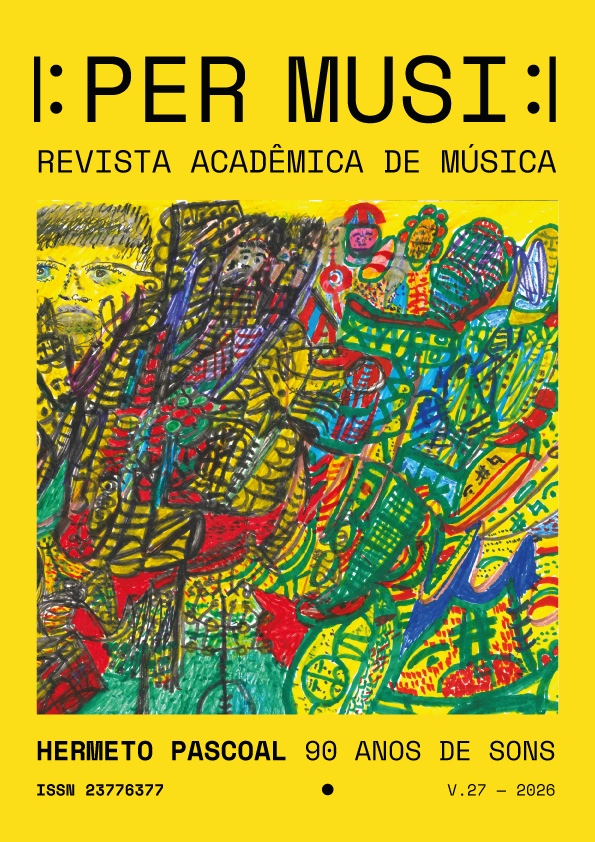
Hermeto Pascoal's "Sound of the Aura"
Technique, Poetics and the Aesthetic Horizon of Tertiary Neo-Auratic Encoding
DOI:
https://doi.org/10.35699/2317-6377.2026.67832Keywords:
Hermeto Pascoal, Sound of the Aura, New Media, Aesthetics, Neo-Auratic EncodingAbstract
This article engages with the work of Costa-Lima Neto (2010, 2020, 2022) on Hermeto Pascoal's concept of "sound of the aura," placing his findings and conclusions in perspective from the notion of "tertiary neoauratic coding" (Araújo Costa 2023). Our analysis articulates Luigi Pareyson's Theory of Formativity with Vincenzo Caporaletti's Theory of Audiotactile Formativity. The article distinguishes technique, poetics, and the aesthetic horizon of the "sound of the aura." The technique crystallizes in the album Lagoa da Canoa, Município de Arapiraca (Pascoal, 1984), its poetics are made explicit in Festa dos Deuses (Pascoal, 1992), within the horizon of secondary neoauratic coding, and its reactivations in the 21st century project new values associated with tertiary neoauratic coding. Therefore, it is argued that the persistence of the technique also involves a transformation of its mediological, authorial, and interactional regime.
References
Araújo Costa, Fabiano. 2023. “Audiotactile Spaces of Interaction and Tertiary Neo-Auratic Encoding: A Brief Essay on Music, Culture and New Media”. Acusfere: suoni, culture, musicologie, v. 2, Lucca: LIM - Libreria Musicale Italiana, p. 33-48.
Borém, Fausto e Araújo, Fabiano. 2010. “Hermeto Pascoal: experiência de vida e a formação de sua linguagem harmônica”. Per Musi. 22 (jul. 2010), 1–22.
Benjamin, Walter. 2012 [1936]. “A obra de arte na era de sua reprodutibilidade técnica”. In: Magia e técnica, arte e política: ensaios sobre literatura e história da cultura. Tradução de Sérgio Paulo Rouanet. São Paulo: Brasiliense.
Attali, Jacques. 1985 [1977]. Noise: The Political Economy of Music. Tradução de Brian Massumi. Minneapolis: University of Minnesota Press.
Caporaletti, Vincenzo. 2014. “Il Principio Audiotattile come Formatività”, in : Sbordoni, Alessandro (a cura di), Improvvisazione Oggi, Lucca: LIM - Libreria Musicale Italiana, p. 29-42.
Caporaletti, Vincenzo. 2015. “Neo-Auratic Encoding: Phenomenological Framework and Operational Patterns”. In: Borio, Gianmario, ed. Musical Listening in the Age of Technological Reproduction. Aldershot: Ashgate, p. 233-252.
Caporaletti, Vincenzo. 2026. Teoria das músicas audiotáteis: uma introdução. Tradução de Ivone Benedetti. Prefácio à edição brasileira de
Fabiano Araújo Costa. Campinas: Editora Unicamp.
Costa-Lima Neto, Luiz. 2010. “O cantor Hermeto Pascoal: os instrumentos da voz”. Per Musi, p. 44-62. https://doi.org/10.1590/S1517-75992010000200004.
Costa-Lima Neto, Luiz. 2020. “The First ‘Sound of the Aura’ of Hermeto Pascoal (1984): Hearing the Spoken Voice as a Sung Melody”. IASPM Journal, v. 10, n. 2, p. 20-37.
Costa-Lima Neto, Luiz. 2022. “Passado, presente e futuro do Som da Aura, uma criação de Hermeto Pascoal, com a colaboração de Jovino Santos Neto (1984-2022...)”. Voz e Cena, Brasília, v. 3, n. 1, p. 97-118.
Figurt, Albert. 2020. “The Self-Splintering Evolution of Music Videos in the Era of Digital (DIY) Audio/Visual Streams”. In: Lovink, Geert; Treske, Andreas, eds. Video Vortex Reader III: Inside the YouTube Decade. Amsterdam: Institute of Network Cultures, p. 69-95.
Hill, Peter. 1995. The Messiaen Companion. Portland: Amadeus Press.
Messiaen, Olivier. 1944. Technique de mon langage musical. Paris: Alphonse Leduc.
Pareyson, Luigi. 1993. Estética: Teoria da formatividade. Petrópolis: Vozes.
Pareyson, Luigi. 2007. Esthétique: théorie de la formativité. Tradução de Gilles A. Tiberghien. Paris: Éditions Rue d’Ulm.
Peppercorn, Lisa. 1991. Villa-Lobos: The Music. London: Kahn & Averill.
Schoenberg, Arnold. 1975. Style and Idea. Tradução de Leo Black. London: Faber & Faber.
Discografia
Pascoal, Hermeto. Festa dos Deuses. Rio de Janeiro: PolyGram, 1992. 1 CD.
Pascoal, Hermeto. Lagoa da Canoa, Município de Arapiraca. São Paulo: Som da Gente, 1984. 1 LP.
Vídeos
Chassol, Christophe. Big Sun [vídeo]. YouTube, 2015. Disponível em: https://www.youtube.com/watch?v=VL4gZ9ve6E. Acesso em: 24 mar. 2026.
Cinquiéme (Producer), & Billon, Yves. (Director). (1997). Hermeto Pascoal - L'Allume Tropical. [Video/DVD] Qwest TV. Retrieved from https://video.alexanderstreet.com/watch/hermeto-pascoal-tropical-oddball
Collier, Jacob. Overjoyed Challenge [vídeo]. YouTube, 2016. Disponível em: https://www.youtube.com/watch?v=MvXObWVmg_I. Acesso em: 24 mar. 2026.
Farkas, Thomaz. (Diretor). (1981). Hermeto Campeão. [Video], 43 minutos, 16mm. Consultado em: https://www.thomazfarkas.com/filmes/hermeto-campeao/
Mononeon (Dywane Thomas Jr.). Dump Trump, We Don't Want Him [vídeo]. YouTube, 2016. Disponível em: https://www.youtube.com/watch?v=LPZYRQK_cx4. Acesso em: 24 mar. 2026.
Neely, Adam. Deepfake Text-to-Speech (but it's a new form of jazz) [vídeo]. YouTube, 2018. Disponível em: https://www.youtube.com/watch?v=UZzYoOdIXoQ. Acesso em: 24 mar. 2026.
TV Zero Produtora (Produtora), Berliner, Roberto. (Diretor). A Pessoa é para o que nasce. Documentário. Trilha Sonora Original de Hermeto Pascoal. [Video] 1hora e 25minutos. Consultado em: https://play.ebc.com.br/programas/691/a-pessoa-e-para-o-que-nasce
Downloads
Published
Issue
Section
License
Copyright (c) 2026 Per Musi

This work is licensed under a Creative Commons Attribution 4.0 International License.

Except where otherwise noted, contents on this site are licensed under a Creative Commons - Atribuição 4.0 Internacional.