Memories from the Clay
DOI:
https://doi.org/10.35699/2238-2046.2026.59006Keywords:
time and memory, affection, artistic practice, clay, ceramicsAbstract
The shoot stems from activities carried out in the Postgraduate Programme in Arts (IA/Unesp), in the course “Storytelling and Walking with Ancestors: Ceramics and Its Contributions to Decolonial Thinking”, from the research line of Artistic Processes and Procedures. The classes aimed to relate practices with clay, based on the participants’
affections and memories. Thus, the creations focused on the search for the deepest and most meaningful feelings, affectively. The Infinite was conceived from a wristwatch
belonging to a father who is no longer with us, but whose watch stopped at the moment
of his death. This object/artifact was part of a tactile memory game (touching it and
describing it with closed eyes, and the owner had to identify himself based on a colleague’s
interpretations). We divided the shoot into two parts: the first is the arrival in the classroom
and the affective act; the second presents Joana D’Barro, the mother who received our
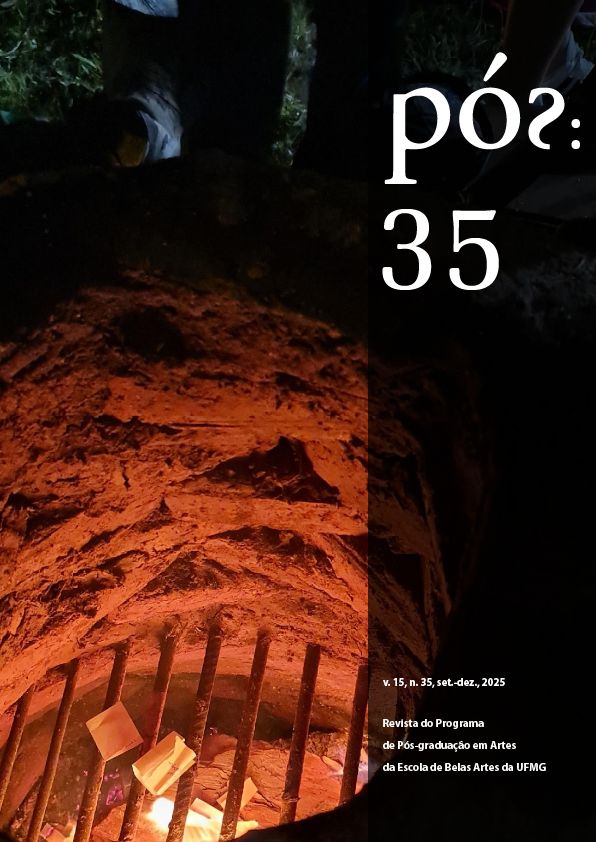
requests in her flames. Joana D’Barro is a kiln that illustrates the process of firing the pieces,
not to consume them, but to give them durability, retaining a little more of the memory of the creations.
Downloads
Downloads
Published
Issue
Section
License
Copyright (c) 2026 Walter Rodrigues Marques, Priscila Leonel

This work is licensed under a Creative Commons Attribution-NonCommercial 4.0 International License.
Authors who publish in this journal agree to the following terms:
- Authors retain copyright and grant the journal the right of first publication, with the work simultaneously licensed under the a Creative Commons Attribution-NonCommercial 4.0 International License that permits sharing of the work with acknowledgement of authorship and initial publication in this journal;
- Authors are permitted to enter into additional contracts separately, for non-exclusive distribution of the version of the work published in this journal (e.g., the Creative Commons Attribution License).
- Authors are permitted and encouraged to publish and distribute their work online (e.g., in institutional repositories or on their home page) at any point before or during the editorial process, as this may generate productive changes as well as increase the impact and citation of the published work.
- It is the responsibility of the authors to obtain written permission to use in their articles materials protected by copyright law. Revista PÓS is not responsible for copyright breaches made by its contributors.







 |
|