About the Journal

Texto Livre is an open access online journal on a continuous publication basis. It is sponsored by the School of Letters of the Federal University of Minas Gerais (Brazil) since 2008. Texto Livre welcomes submissions of articles, experience reports, essays, critical reviews, interviews and dossiers, by peer-reviewed author, that address the multi/pluri/inter/transdisciplinarity in the lines of linguistics, semiotics, education, communication, information and computing technologies, translation, robotics and free culture related to technologies. Its mission is to promote scientific production along these lines, allowing researchers from Brazil and abroad to disseminate their research and contribute to the debate and scientific progress in the area. Related topics of interest to this periodical are: technology-mediated language teaching, communication in the media, use of technologies in teaching-learning, open educational resources, free culture, digital inclusion, digital literacy, impact of technologies on translation, dissemination in free software and other themes related to technologies. The journal accepts manuscripts in Portuguese, Spanish, English, and French. Texto Livre is an academic publication intended for researchers as well as non-academic audiences interested in approaches to the topics addressed by the journal.

Current Issue

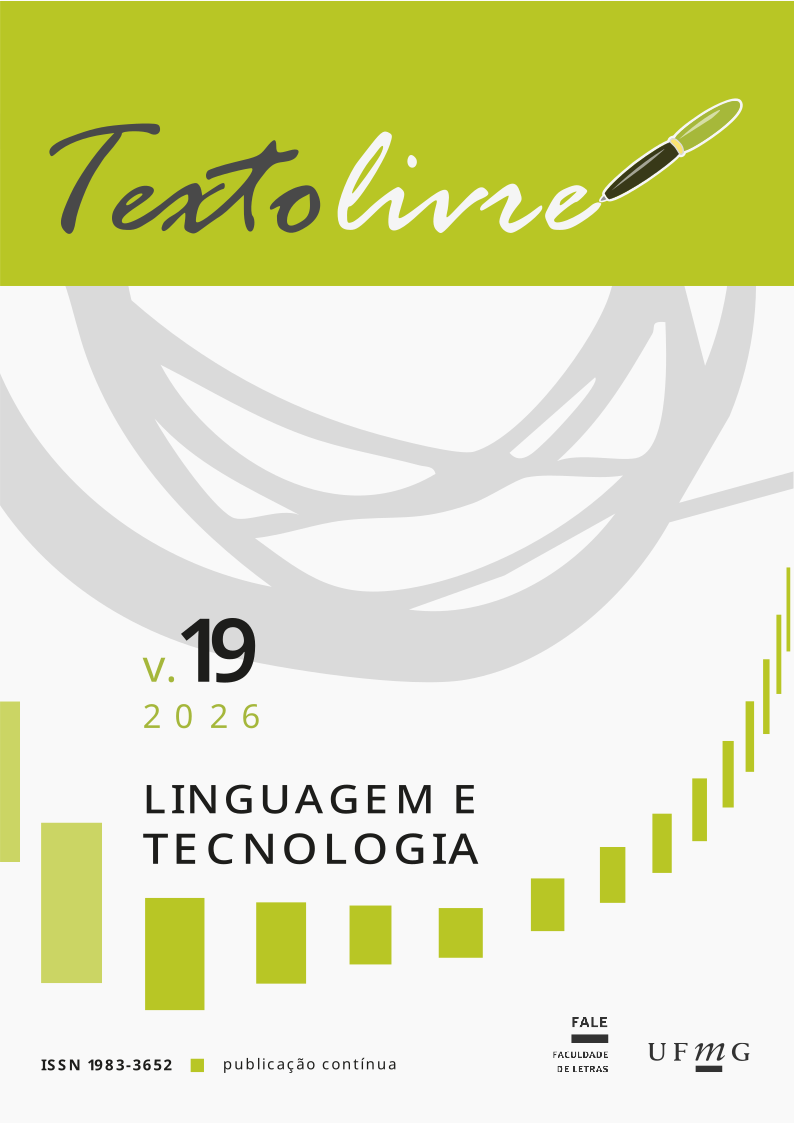
Vol. 19 (2026): Texto Livre: Linguagem e Tecnologia
Belo Horizonte-MG, Brazil

Published: 04/11/2025

Continuous publication

Published: 2025-11-04

Articles

  • Analysis based on the Didactic Choreographies of the integration of digital technologies in the bachelor’s degree in Mathematics

    Douglas Carvalho de Menezes, Muriell Francisco da Costa, Douglas Marin
    e60147
    DOI: https://doi.org/10.1590/1983-3652.2026.60147
  • Online press conferences and the legitimization of the Executive Branch in Costa Rica (2022-2024)

    Jose Pablo Salazar Aguilar, Cristian Bonilla Cruz
    e58698
    DOI: https://doi.org/10.1590/1983-3652.2026.58698
  • Digital competence and artificial intelligence design and validation of an instrument for secondary school students through expert judgement

    María Rubio-Gragera, Antonio de Padua Palacios-Rodríguez, Ernesto Colomo-Magaña
    e57860
    DOI: https://doi.org/10.1590/1983-3652.2026.57860
  • Multimodal oral practices exploring reality shows in teaching German as an additional language

    Marceli Cherchiglia Aquino, Sofia Leria Alcoforado
    e60137
    DOI: https://doi.org/10.1590/1983-3652.2026.60137
  • Environmental education for Lower Secondary School development of an application for environmental pollution classes

    Thais Lemos dos Santos, Paulo Roberto Soares Stephens
    e57811
    DOI: https://doi.org/10.1590/1983-3652.2026.57811
  • Science communication and online engagement analysis of the journal Science on Instagram and Facebook

    Suellen, Asdrúbal Borges Formiga Sobrinho, Marina Silva Bicalho Rodrigues
    e59368
    DOI: https://doi.org/10.1590/1983-3652.2026.59368
  • Generic stylistics in academic text production assisted by Generative Artificial Intelligence

    Róger Sullivan Faleiro, Ana Emília Klein
    e60146
    DOI: https://doi.org/10.1590/1983-3652.2026.60146
  • Hello, digital language! A techno-discursive analysis of the Sallve brand on Instagram

    Maiara Luiza Schönardie dos Santos, Dieila dos Santos Nunes
    e60415
    DOI: https://doi.org/10.1590/1983-3652.2026.60415
View All Issues